Massacre of Journalists in Gaza: Israel’s War Crime and Critical Test for International System
DID Press: Recent Israeli airstrikes on Gaza’s Nasser Hospital, which claimed the lives of at least five international journalists, have once again highlighted one of the most sensitive and controversial aspects of the ongoing conflict in Palestine: Targeting journalists and media outlets deliberately.
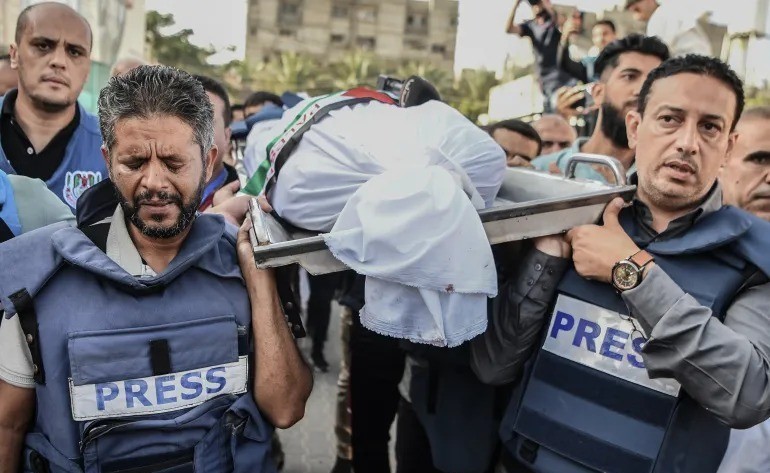
With the simultaneous killing of five reporters in Khan Yunis, the number of journalists killed in Gaza by Israeli forces has now exceeded 280. This shocking figure underscores a disturbing reality: Israel’s actions blatantly disregard internationally accepted norms and principles, crossing ethical and humanitarian boundaries through sheer brutality.
This phenomenon is not only an overt moral and human atrocity but also carries profound implications for international law and relations, which cannot be ignored.
First, it is important to consider the protected status of journalists in armed conflicts. Under the Geneva Conventions and their Additional Protocols, journalists and media personnel operating in war zones are granted full immunity and must be protected like civilians. Targeting them—especially while they are performing their professional duty to report the truth—constitutes a clear war crime. From this perspective, Israel’s direct strike on sites where journalists were reporting represents a deliberate attempt to silence the truth and obscure the humanitarian catastrophe in Gaza.
In reality, the primary objective of Israel’s journalist killings is a desperate and shameless effort to conceal its war crimes in Gaza. Yet, this regime seems to have forgotten that such attempts are futile. Even cooperation with major Western media outlets over the past two years has failed to prevent widespread reporting of Israel’s atrocities, resulting in global outrage. Hundreds of thousands of conscious citizens, even in ostensibly advanced Western nations, continue to protest against Israel’s actions and hold their governments accountable for supporting Tel Aviv.
From a media perspective, the massacre sends a clear message: Israel seeks to control the narrative of the war exclusively through its own propaganda channels and suppresses any independent or dissenting voices at the source.
In this context, international media organizations such as Reuters, Associated Press, and Al Jazeera remain among the few credible sources documenting crimes in Gaza. Weakening these outlets effectively reduces the flow of free information. This demonstrates the parallel “war of narratives” accompanying the military conflict, wherein Israel attempts to dominate the information field by eliminating journalists—a strategy that has thus far failed to prevent global awareness of the situation.
Politically and geopolitically, the consequences of this strategy extend beyond Palestine’s borders. The wave of condemnation from the United Nations, Western governments, and human rights organizations reflects that even Israel’s traditional allies cannot easily overlook such egregious acts. Moreover, the journalists targeted were affiliated with international media, amplifying the impact of their deaths on global public opinion. This pressure has weakened Israel’s diplomatic position and opened new legal avenues against its military and political leaders in international courts.
Strategically, targeting journalists can backfire. While Israel aims to prevent the dissemination of evidence and reporting, the killing of journalists becomes headline news worldwide, further undermining its claims of “self-defense.” Such media suppression portrays Israel as a state systematically violating freedom of expression and human rights.
Ultimately, the massacre of journalists in Gaza is not an isolated incident; it is part of a broader effort to silence resistance, suppress the depiction of Palestinian suffering, and distort the truth of the conflict.
If the international community remains silent in the face of this crime, it effectively legitimizes the suppression of media worldwide.
Therefore, pursuing legal accountability and diplomatic pressure on Israel is not only a humanitarian imperative for the victims and their families but also a critical test of the credibility of the international system in upholding human rights and media freedom.
By Rahel Mousavi