US Delegation’s Kabul Visit: More than Prisoner Swap
DID Press: By accepting talks with U.S. representatives, Taliban’s caretaker government seeks to demonstrate its engagement is not limited to the East and its regional neighbors, but that it is also prepared to establish balanced relations with the West.
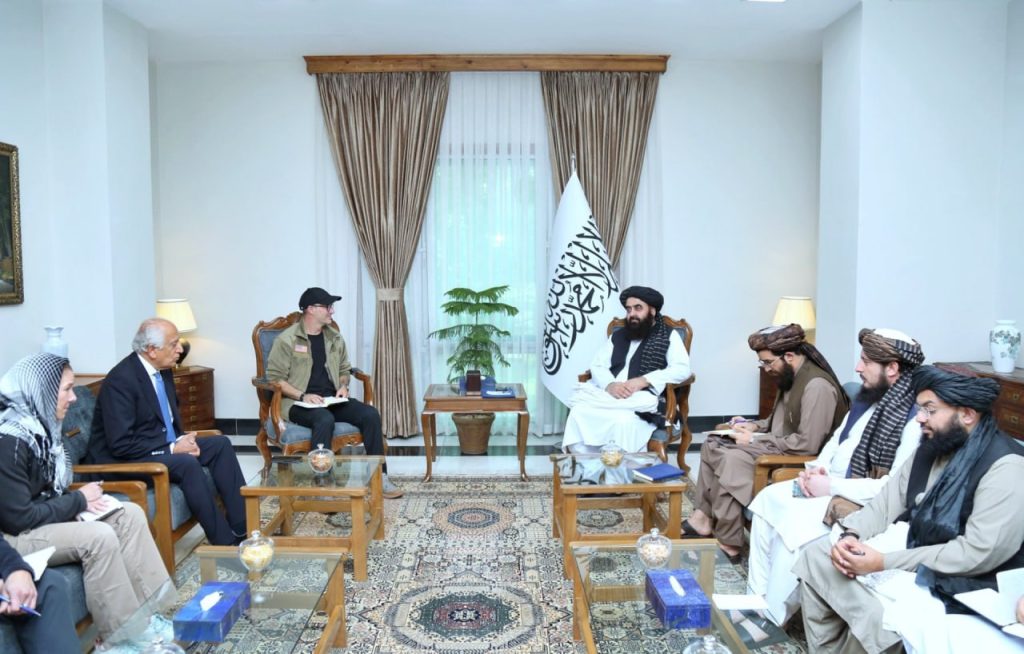
A New Prisoner Swap Deal Between Taliban and U.S. in Kabul
The recent meeting in Kabul between U.S. Special Envoy for Hostage Affairs Adam Boehler and former U.S. peace envoy Zalmay Khalilzad with Taliban officials was presented publicly as being centered on prisoner exchanges. Yet, multiple indicators suggest that this trip was not merely a humanitarian gesture, but rather part of a broader strategic agenda with hidden objectives.
A) Political Legitimacy for the Taliban
Since seizing power in 2021, Taliban have faced international isolation. Their biggest challenge has been to gain political legitimacy and recognition as Afghanistan’s lawful government. Even a limited dialogue with a U.S. delegation—framed around prisoners—provides the Taliban with the chance to present themselves as credible actors on the global stage rather than merely a local power.
B) Economic Necessities and Sanctions Pressure
Afghanistan remains in deep economic and humanitarian crisis. Limited access to foreign reserves, banking restrictions, and a domestic downturn have strained the caretaker government. The U.S. and Western states have tied humanitarian aid and economic relief to commitments on human rights and prisoner releases. Negotiations around detainees, therefore, could serve as a gateway for broader economic engagement and partial sanctions relief.
C) Prisoners as a Diplomatic Lever
The release of American hostages and detainees is a highly sensitive issue in U.S. domestic politics. Any progress here can be framed as a diplomatic win for Washington. At the same time, the Taliban view prisoners as bargaining chips to secure political and economic concessions. Thus, prisoner talks become a mutually valuable but deeply strategic tool.
D) Economic Prospects and Investment
Informal parts of the discussions also touched on Afghanistan’s economic potential. The Taliban are eager for foreign investment in mining, energy, and infrastructure. The U.S., in turn, can condition such opportunities on specific commitments, thereby expanding its economic and geopolitical influence in Afghanistan. In this sense, detainees may serve as a pretext for initiating deeper economic talks.
E) Regional and International Signaling
Holding such a meeting in Kabul sends a clear message to regional players. The U.S. is signaling that it retains the capacity to engage directly with the Taliban government—potentially altering the calculations of Pakistan, Iran, China, and Arab states. For Washington, it reaffirms that it is not absent from the Afghan equation.
F) Managing Taliban Relations with Regional Powers
Another hidden dimension of the visit lies in U.S. efforts to shape the Taliban’s ties with other global and regional powers. With China and Russia expanding their cooperation with Kabul, and Iran and Pakistan maintaining close links, Washington is unwilling to see Afghanistan slip entirely into non-Western spheres of influence. A U.S. presence in Kabul underscores its intention to remain an active player in Afghanistan geopolitics.
For the Taliban, meanwhile, agreeing to talks with U.S. envoys allows them to claim that their foreign policy is not exclusively tilted toward the East, but is instead balanced—leveraging great-power competition to extract political and economic benefits.
G) ISIS-K as a Managed Tool in U.S. Policy
A less overt but significant aspect of the visit concerns the presence of ISIS-K. While Washington officially cites “grave concerns over terrorism,” regional assessments suggest that the U.S. seeks not the elimination but the management of ISIS-K. For the U.S., ISIS-K functions as a strategic instrument to reshape power dynamics in Afghanistan and the wider region.
ISIS-K serves two key purposes for Washington:
To pressure the Taliban into sustained dialogue with the U.S. under the pretext of counterterrorism.
To use the threat of ISIS as a lever for indirect influence over the security environments of Central Asia, Iran, Russia, and China.
From this perspective, the prisoner exchange may also have served as a cover for deeper consultations on the management and containment—rather than eradication—of ISIS-K.
Conclusion
U.S. delegation’s visit to Kabul and the agreement on prisoner exchanges cannot be seen purely as a humanitarian act. Beneath the surface, it carries multi-layered objectives: gradual legitimization of the Taliban caretaker government, opening channels for economic engagement, shaping Kabul’s relations with global powers, and preserving U.S. geopolitical leverage in Central Asia.
Additionally, terrorism—and ISIS-K in particular—was almost certainly on the agenda. Given Washington’s past role in the emergence of such groups, the U.S. appears more focused on controlling ISIS-K as a strategic tool than on dismantling it entirely.
Thus, Kabul talks should be understood as part of a larger, more complex scenario—where prisoner exchanges serve as an entry point, but the real aims lie in security, political, and economic domains.
Ultimately, these negotiations mark not the end of tensions in Afghanistan, but the beginning of a new phase in the power game between the Taliban and the United States—one with profound implications both for Afghanistan’s future and the region’s geopolitical balance.
By Mohsen Mowahed