Kandahar Meeting and Bagram: Taliban to Redefine Security Priorities
DID Press: A direct invitation from Hibatullah Akhundzada, the Taliban’s supreme leader, to commanders and regional leaders for a three-day meeting in Kandahar province has once again drawn attention to the group’s true center of power. While the Taliban government in Kabul presents a more political and moderate image, major strategic and security decisions continue to be made in Kandahar under the personal supervision of Akhundzada.
The focus of this meeting — protection and control of Bagram airbase — carries multiple implications, reflecting the Taliban’s security concerns, internal power dynamics, and geopolitical calculations.
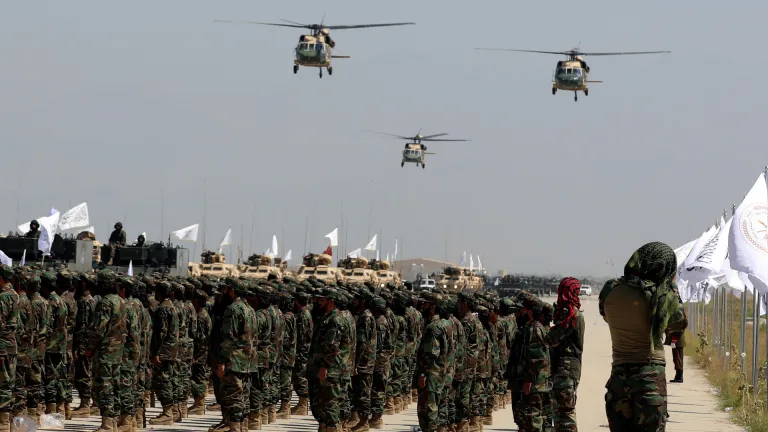
Bagram: A Symbol of Power or a Point of Vulnerability
Bagram Airbase, once the operational hub for U.S. and NATO forces in Afghanistan, holds immense symbolic and strategic significance. For the Taliban, controlling it signifies complete dominance over the remnants of the Western military presence. Yet, Bagram has also become a focal point of internal rivalry within the Taliban.
Security experts argue that Taliban face a dual challenge: on the one hand, the growing threat from rival militant groups such as ISIS-K; and on the other, the risk of insubordination among their own ranks, particularly from commanders who may be drifting away from Kandahar’s central authority. Kandahar meeting can thus be viewed as an effort to reorganize the Taliban’s security structure and reinforce the supreme leader’s authority over regional military figures.
Message to Foreign Powers
The Taliban’s renewed emphasis on Bagram also sends a political signal to regional and international players. Recent reports have suggested possible U.S. intelligence activities in northern Afghanistan and potential interest in reusing old bases for counterterrorism operations.
By convening the Kandahar meeting, the Taliban appearantly wants to demonstrate that they remain highly vigilant aganist any foreign activity inside Afghanistan and that maintaining full control over strategic installations like Bagram is their red line.
This stance also acts as a subtle message to Russia, China, and Iran — countries that maintain pragmatic ties with the Taliban but are equally opposed to any renewed U.S. military presence. While the Taliban benefit from limited cooperation with these regional powers, they are also eager to avoid being viewed as dependent on them. By asserting control over Bagram and publicly rejecting any possibility of its transfer to the U.S., the Taliban are trying to project themselves as an “independent and sovereign force” managing Afghanistan’s security affairs without foreign influence.
From Kandahar’s Centralization to Internal Divisions
The Kandahar meeting may also point to growing internal rifts within the Taliban. Over recent months, tensions have surfaced between Kandahar-based leadership figures and Kabul-based officials such as Mullah Yaqoob and Sirajuddin Haqqani. Control over Bagram — a key logistical and military hub — could become a decisive factor in determining which faction wields greater influence.
Analysts suggest that Akhundzada’s goal in organizing Kandahar summit is to reassert discipline across the Taliban’s military structure and prevent excessive power concentration within the Defense or Interior ministries. His underlying message is clear: all strategic decisions must originate from Kandahar, not Kabul.
Conclusion
The three-day Kandahar meeting represents more than a routine political event — it marks a deliberate effort by the Taliban leadership to consolidate central authority, contain internal challenges, and project strength to both domestic and international audiences. While the status of the Bagram Airbase is only one aspect of this broader equation, the central question remains:
Can the Taliban leadership balance its security imperatives, internal rivalries, and international pressures — or will these competing forces ultimately expose the limits of its power?