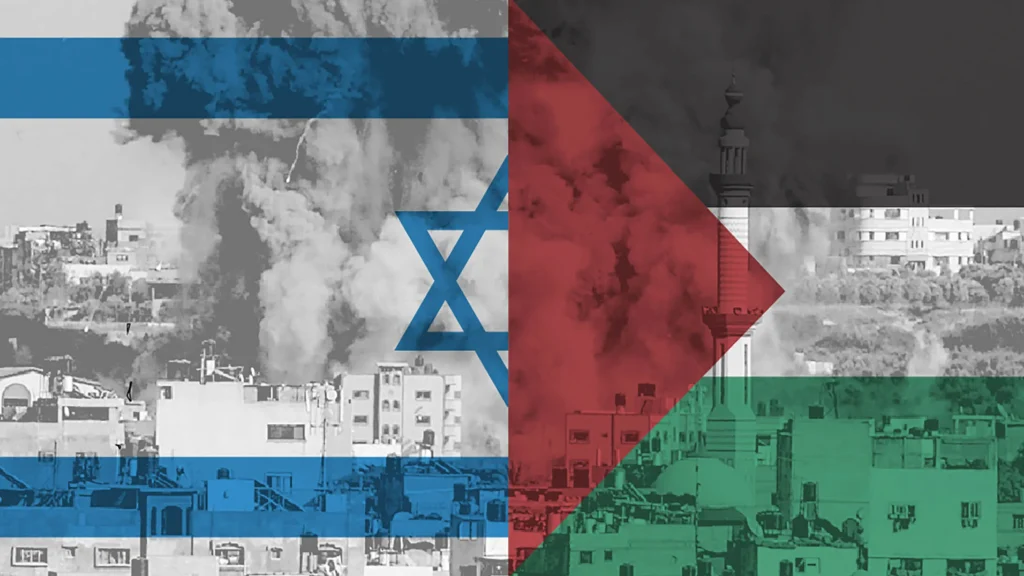
DID Press: Over the past year, Gaza conflict has evolved into a complex arena of military, media, and political confrontation between Palestinian resistance groups and Israel. Contrary to the perception of many Western observers, this war is not merely a bilateral conflict but reflects a deeper competition between two paradigms: the discourse of Islamic resistance and the hegemonic Western framework. The United States and its allies, by openly supporting Israel, are not only safeguarding strategic interests in the Middle East but also using the conflict as a testing ground for evaluating the effectiveness of modern weaponry.
In this environment, Hamas has adopted a markedly different approach from its past practices, seeking to combine its resistant identity with a new phase of political pragmatism and strategic realism. The movement’s response to ceasefire proposals from regional and global powers demonstrates a shift in its decision-making process — a change stemming not from weakness but from political maturity and a deep understanding of both field realities and international dynamics.
Gaza conflict cannot end easily, given its roots in a network of military, economic, and political interests. The U.S. military-industrial complex benefits from continuation of hostilities, while Israel views the conflict as a tool to advance expansionist policies in the occupied territories. Amid this, Hamas has leveraged political prudence to turn opportunities to its advantage. By rejecting imposed Western plans, it preserved its legitimacy while amending key clauses of ceasefire proposals to signal that it does not seek exclusive political control over Palestine. The decision to transfer political management of Gaza and Palestinian affairs to a national consensus is a critical step toward reducing internal divisions and strengthening unity among Palestinian factions.
This approach has also countered Western and Israeli propaganda and enhanced the legitimacy of the resistance in the region. While Hamas has conditionally accepted the ceasefire, it stressed that details of any agreement should be finalized through future negotiations with guarantees from Islamic countries, maintaining its principles of resistance and independent decision-making. Politically, this marks a transition from purely military resistance to a form of “diplomatic resistance,” portraying Hamas as a political actor with significant negotiation power rather than merely a military group.
Additionally, this strategy has diminished the effectiveness of Western media campaigns that portrayed Hamas as the primary source of violence.
Analysis of Hamas’s recent positions indicates a balance between armed resistance and political rationality. Unlike the past, when Palestinian resistance was primarily defined by battlefield engagement, Hamas now demonstrates political evolution, participating in national decision-making and constructive engagement with other Palestinian factions. Emphasizing national consensus, avoiding exclusive governance, and acknowledging the role of Islamic countries reflects the movement’s political and social maturity.
Hamas’s measured response has also been a strategic counter to Israeli and U.S. propaganda. While Tel Aviv and Washington aimed to portray Hamas as a crisis agent, the group’s conditional acceptance of a ceasefire and emphasis on Palestinian welfare presented a rational and people-centered image. This strategic shift creates opportunities to redefine Palestinian resistance at the regional level.
On the international stage, Hamas has successfully leveraged the multipolar global environment to gain implicit support from some non-Western powers, creating a new balance against Western dominance. From this perspective, Hamas now represents not only a symbol of military resistance but also a political actor capable of influencing regional dynamics.
While Gaza conflict continues, recent developments show that the battlefield extends beyond Gaza’s trenches into diplomacy, public opinion, and smart political management. If sustained, this approach can guide Palestine’s future from pure resistance toward a national system rooted in consensus and justice.
Ultimately, Hamas’s experience demonstrates that political rationality within resistance is not a sign of retreat but a prerequisite for survival and advancement against an adversary that has sought to erase Palestinian identity for more than seventy years through military and propaganda means.
By Dr. Sayed Ruhollah Hussaini – Iran’s Cultural Advisor in Afghanistan