DID Press: Sharm el-Sheikh summit, where U.S. President Donald Trump and several Arab and Islamic leaders signed a Gaza ceasefire agreement, was not merely a diplomatic gesture to end the war — it was a striking reflection of the region’s current power dynamics. The event symbolized how Arab political power has increasingly aligned itself with decisions made in Washington and Tel Aviv.
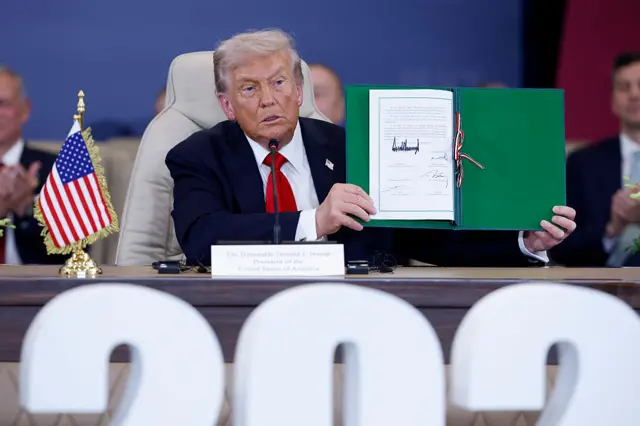
As Trump signed the green folder containing the agreement, followed immediately by the leaders of Egypt, Qatar, and Turkey, the symbolism was unmistakable: the path to peace and even the definition of security in the Middle East remain firmly in the hands of the United States and its allies. The scene recalled earlier decades, when war-weary Arab states, after repeated military defeats, turned toward U.S.-brokered political settlements.
The core issue in Sharm el-Sheikh was not whether the Gaza war should end — an undeniably human and urgent goal — but rather how the framework of the deal was once again drafted without meaningful Palestinian representation or recognition of their fundamental demands. As seen previously in the “Abraham Accords,” much of the Arab world today appears to have chosen political survival over resistance, accepting an emerging U.S.–Israeli regional order where Israel is no longer the former enemy but the central player in regional security.
The symbolic gesture of Egyptian President Abdel Fattah el-Sisi awarding Trump the “Nile Medal” underscored this shift. Egypt, once the vanguard of Arab resistance to Israel, now plays the role of a “neutral mediator” — in reality, an actor largely aligned with Western and Israeli interests. Across the Arab world, the move sparked criticism from observers who saw the summit as less a peace initiative than the consolidation of a “subordinate order” in which Arab states act as compliant spectators to decisions made by major powers.
Adding to this sentiment were remarks by Pakistani Prime Minister Shehbaz Sharif, who praised Trump’s “efforts to end the Gaza crisis” and called him deserving of a Nobel Peace Prize. Such statements, critics argue, reveal the deepening pattern of political dependence among regional governments — particularly as Pakistan, facing border tensions with Afghanistan and internal economic strains, seeks closer ties with Washington.
Politically, the Sharm el-Sheikh summit marked the culmination of what can be described as a strategy of “managed normalization.” Its goal is not to resolve the Palestinian question at its roots but to contain it within a controllable framework designed by global powers. Backed by Washington, Israel aims to shed its historical isolation and emerge as a legitimate regional partner in shaping the Middle East’s future.
Yet this process carries long-term consequences. Excluding authentic Palestinian voices from the negotiating table, eroding public trust across Arab societies, and perpetuating a sense of injustice may sow the seeds of future instability.
On the surface, the Sharm el-Sheikh meeting projected an image of “successful diplomacy.” But beneath that image lies a deeper truth — the redefinition of power and political subordination in the Arab world, where regional actors are no longer shaping policy but merely implementing the strategic agendas of Western powers, led by the United States.
By Sayed Reza Mousavi