Survey: Afghan Migrants in Iran Support Resistance Axis, Criticize Tehran’s Taliban Policy
DID Press: A recent scientific survey indicates that, contrary to common media narratives, a substantial portion of Afghan migrants residing in Iran express support for Iran’s regional policies, particularly its backing of the resistance axis, while showing a markedly more critical stance toward Iran’s policy regarding the Taliban.
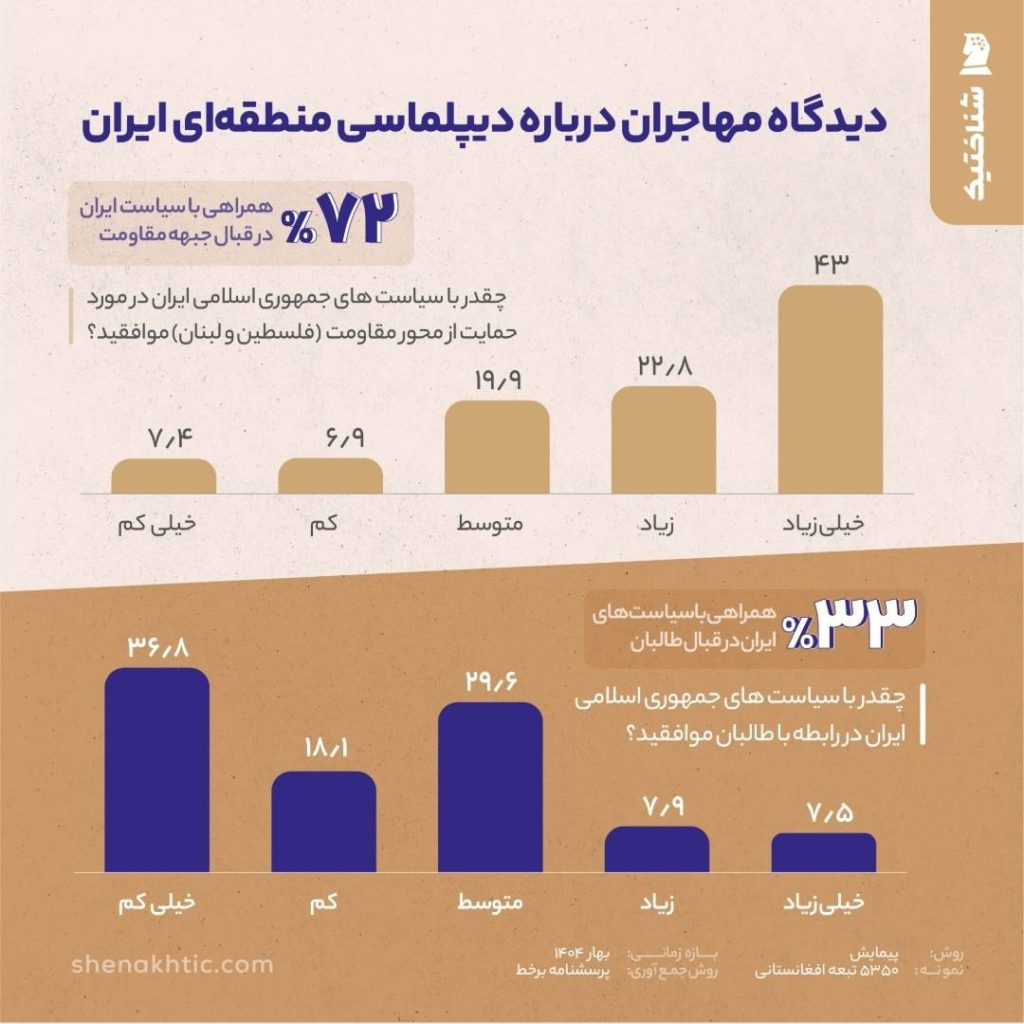
The survey, conducted in spring 2025 by the “Shenakhtik” Center among 5,350 Afghan nationals living in Iran, found that 72% of respondents support Iran’s policies on the resistance axis (Palestine and Lebanon). Of these, 43% indicated “very high” support, 22.8% “high,” and 19.9% “moderate.” Only 14.3% reported “low” or “very low” support.
This demonstrates that the resistance discourse enjoys considerable social and emotional support among Afghan migrants, contradicting some securitized portrayals of this community.
In contrast, the survey shows limited support for Iran’s Taliban policy, with only 33% of respondents expressing agreement. Specifically, 7.5% indicated “very high,” 7.9% “high,” and 29.6% “moderate” support, while 18.1% rated it “low” and 36.8% “very low,” reflecting significant doubt, concern, or dissatisfaction.
Experts suggest that this gap reflects Afghan migrants’ lived experiences, historical memory, and security concerns, viewing the Taliban not as a normal political actor but as a direct threat to Afghanistan’s future.
The survey also highlights that Afghan migrants, contrary to attempts to portray them as aligned with rival regional discourses, maintain close intellectual and emotional ties with Iran on regional issues and opposition to Israel.
Analysts believe that policies promoting social inclusion, avoiding discrimination, and consciously integrating migrants could transform this social capital into a strong tool for Iran’s soft power and regional cohesion.
However, ignoring the real demands of migrants—especially regarding Afghanistan and the Taliban—could weaken existing solidarity and create opportunities for hostile media exploitation.
The clear message: rethinking the “migrant threat” narrative and aligning policies with social realities is essential.