DID Press: Crisis in the Middle East is intensifying as a wave of political reactions and military developments from late Saturday into Sunday suggests tensions between Iran, the United States, and Israel have entered an unprecedented phase.
U.S. Senator Bernie Sanders sharply criticized Washington’s policies, saying that while Americans are told there is no funding for healthcare, housing, or education, “billions of dollars are being spent on an illegal war with Iran.” He added that the government should work for the public rather than the military industry, Israel, or lobbying groups.
In Pakistan, the country’s grand mufti warned against what he described as efforts by the United States and Israel to create divisions in the region and called for support for Iran against what he termed “bullying behavior.” Meanwhile, the foreign minister of China expressed concern about the conflict expanding, saying the war “should never have started and benefits no one.”
On the military front, a spokesperson for the Islamic Revolutionary Guard Corps said missiles used in recent Iranian operations were mostly first- and second-generation models, adding that more advanced and long-range missiles may be deployed in later phases.
Arab media reported powerful explosions at a U.S. military base in Saudi Arabia, while reports from Bahrain indicated that a U.S. facility caught fire after being struck by Iranian projectiles.
In Kuwait, military officials confirmed that fuel storage tanks at the country’s international airport were targeted by unmanned drones.
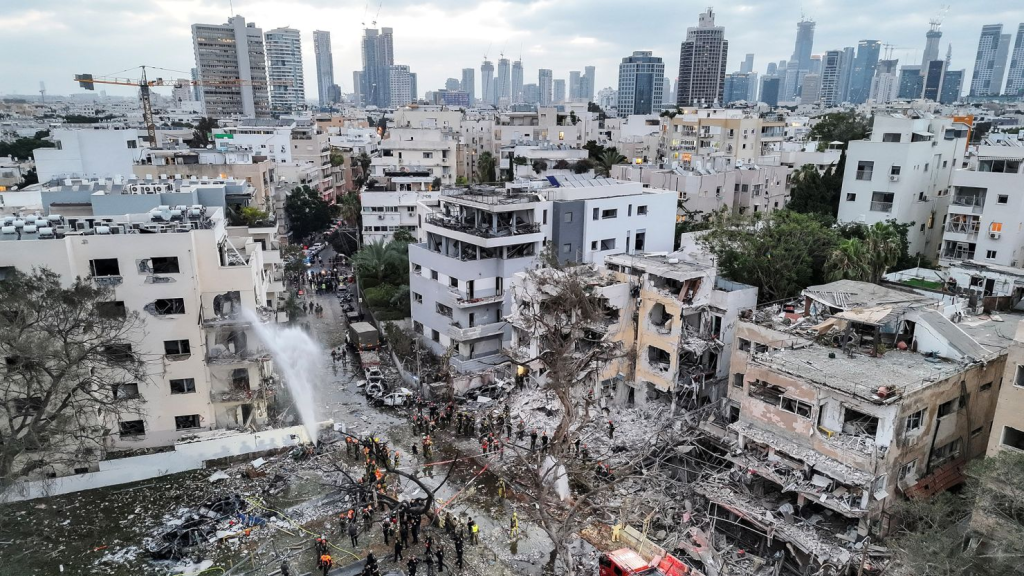
In northern Israel, air-raid sirens sounded repeatedly in Nahariya and areas across the Galilee. The Hezbollah group in Lebanon said it carried out 33 missile, drone, and ground operations against Israeli positions in a single day and targeted the Glilot base near Tel Aviv with suicide drones. Israeli media also reported several explosions in Tel Aviv.
Lebanese journalists reported that Israel conducted a large operation in Lebanon aimed at recovering the remains of missing Israeli pilot Ron Arad, though the attempt was reportedly thwarted after clashes with Hezbollah fighters.
In Iraq, Akram al-Kaabi, leader of the Harakat Hezbollah al-Nujaba, warned in response to U.S. strikes that Donald Trump “will no longer find peace.”
At the regional level, the defense minister of Saudi Arabia said in a phone call with the prime minister of Jordan that Riyadh supports efforts to maintain regional security and stability.
Meanwhile, the Washington Post reported that U.S. capabilities to counter large waves of drones in Middle East conflicts remain insufficient.
Taken together, these developments suggest the confrontation has expanded beyond limited clashes and now involves multiple countries across the region, raising fears among analysts that the security dynamics of the Middle East could be fundamentally reshaped.