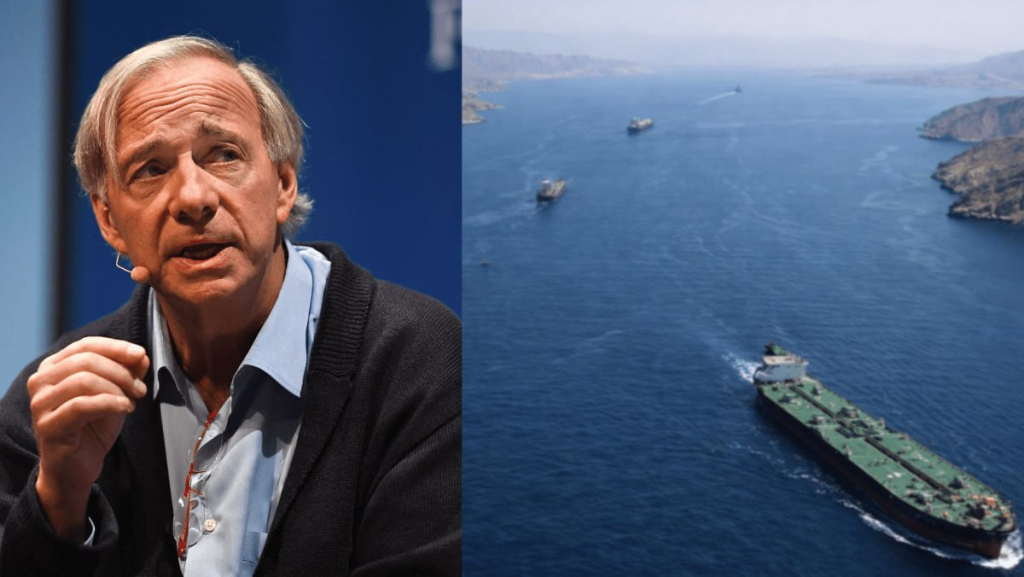
DID Press: American economist and author Ray Dalio has outlined the strategic stakes of the ongoing US-Israel-Iran confrontation in his article, “It All Depends Who Controls the Strait of Hormuz: The Final Battle.” Dalio argues that the decisive front is not on land but in the Strait of Hormuz, a vital chokepoint through which roughly one-fifth of the world’s oil passes, crucial to the global balance of power.
Key Points:
- Hormuz as the Decisive Factor – Dalio emphasizes that if Iran maintains control over the Strait—or uses it as a bargaining tool—the United States is effectively at a strategic disadvantage in the current conflict.
- Historical Parallel: Suez Crisis – He compares the situation to Britain’s loss of the Suez Canal in 1956, which marked the decline of its global empire. Similarly, failure to secure Hormuz could signal the end of U.S. global hegemony.
- Economic Implications & Global Order – Dalio notes that Iran has allowed tankers trading in Chinese yuan passage, challenging the petrodollar system and U.S. borrowing power. Capital and allies tend to shift rapidly toward the perceived winner; a loss in Hormuz could trigger capital flight from U.S. debt and currency markets.
- Domestic U.S. Constraints – Anti-war sentiment and upcoming midterm elections limit Washington’s ability to bear the human and financial costs of a full-scale war, Dalio argues, representing the country’s key vulnerability in this “final battle.”
- Role of China and Russia – While Iran occupies the frontline, Dalio suggests China stands to gain the most from a relative weakening of U.S. influence, seeing this as part of a 500-year historical pattern where emerging powers challenge dominant nations along key trade routes.
Conclusion:
Dalio warns that if the United States cannot ensure free and unimpeded passage through the Strait of Hormuz, the event will mark a historic failure, with irreversible consequences for energy prices, global power structures, military alliances, and financial markets—especially gold and currency.