Trump Struggle to Rewrite US Defeat in Afghanistan
DID Press: US President Donald Trump has once again stirred controversy in US foreign policy by proposing to “reclaim” Bagram Air Base in Afghanistan — a move that, according to analysts, is less about military feasibility and more about reshaping America’s global image and rewriting the narrative of its defeat in Afghanistan.
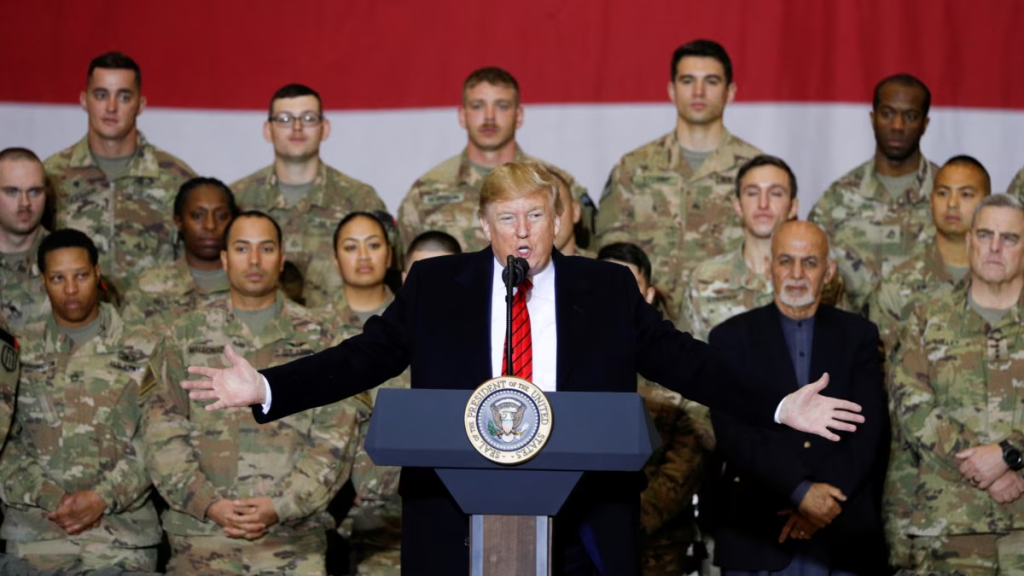
However, the mere proposal has sparked widespread reactions and concerns. Both the Taliban government and key regional powers strongly opposed the idea. Russia, China, and Iran — three major regional players — have warned against any U.S. attempt to retake the base or redeploy troops there, calling such a move a threat to regional order and stability with potentially grave security consequences.
Currently, representatives of four influential regional countries — China, Russia, Iran, and Pakistan — are holding consultations in Moscow to discuss Afghanistan’s security situation, specifically the fate of the Bagram Air Base. Analysts say this reflects a collective regional consensus that any U.S. effort to reclaim Bagram would be unacceptable, even if the Taliban were to come under heavy American pressure.
Coinciding with the Moscow meeting, Trump reiterated his stance at a ceremony marking the 250th anniversary of the U.S. Navy’s founding, warning that neglecting Bagram will have “dangerous consequences” for Afghanistan’s future — a signal of his determination to bring the U.S. back into Afghanistan’s strategic equation.
Why Bagram Matters to the U.S.
- Rewriting the Narrative of Defeat
Bagram symbolizes America’s lost power in Afghanistan. By advocating the idea of reclaiming it, Trump seeks to project an image of strength and decisiveness — in contrast to what he portrays as President Biden’s weakness during the withdrawal. His aim appears to be restoring U.S. prestige and turning the memory of military retreat into a symbol of regained authority. - Linking Afghanistan to the U.S.–China Rivalry
Trump has described Bagram not merely as a military base but as a critical geopolitical asset near a sensitive regional zone. He has claimed that “China is now using that location for its nuclear purposes” — suggesting that Washington must prevent Beijing, its chief global rival, from exploiting the strategic vacuum left by the U.S. withdrawal. This frames Bagram within the broader context of great-power competition rather than as a purely Afghan issue. - Threats as a Bargaining Tool
Trump’s warnings — including his statement that “bad things will happen” if the Taliban refuse to cooperate — are widely seen by observers as a tactical move. Analysts believe he is using the threat of force as leverage, not necessarily seeking to militarily retake Bagram, but rather to use it as a political bargaining chip domestically and internationally.
Strategic and Practical Obstacles
Despite Trump’s rhetoric, several significant barriers make any U.S. return to Bagram highly unlikely.
The Taliban’s opposition: The group has firmly rejected any talk of foreign bases on Afghan soil.
The cost of war: Maintaining control over Bagram in a hostile environment would require tens of thousands of troops and billions of dollars — contradicting Washington’s long-declared goal of ending “forever wars.”
Violation of the Doha Agreement: Any U.S. redeployment would breach the 2020 Doha Agreement, undermining America’s diplomatic credibility and exposing it to severe political and financial costs.
Conclusion: Reclaiming Symbols, Not Bases
Ultimately, Trump’s proposal to retake Bagram seems more symbolic than practical — an attempt to rewrite the story of America’s defeat in Afghanistan and appeal to nationalist voters at home. While this narrative might resonate domestically, geopolitical and on-the-ground realities make such a move nearly impossible.
For now, Bagram stands not just as a former U.S. military base, but as a battleground of narratives — where Washington seeks to transform the image of defeat into a symbol of power, and Kabul frames that same defeat as a triumph of national independence.
By: Rahel Mousavi