Regional Consensus in Moscow Signals End of US Role in Afghanistan
DID Press: Recent developments at “Moscow Format” meeting have once again placed Afghanistan at the heart of regional geopolitics. The unified position of regional powers — from Iran and Russia to China, India, and the Central Asian states — against the establishment of any foreign military infrastructure in Afghanistan represents more than a diplomatic statement. It signals the emergence of a new strategic consensus aimed at countering a potential U.S. return to the country.
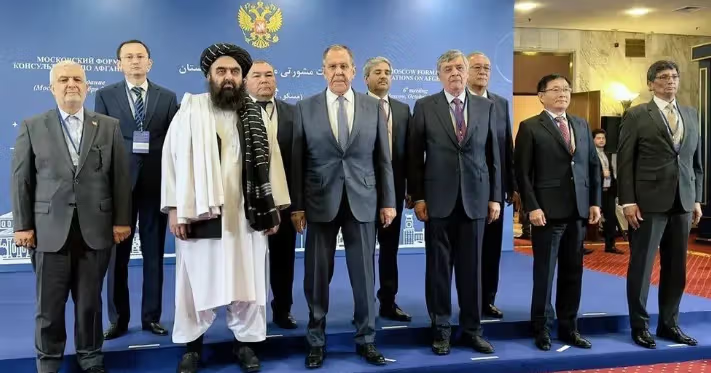
On the surface, the final communiqué from the Moscow meeting merely reiterated opposition to the deployment of foreign forces. In substance, however, its message was clearly directed at Washington — particularly after U.S. President Donald Trump renewed calls to “reclaim” Bagram Air Base, a stance he has repeated several times, sometimes with threats. Bagram, once the operational heart of US two-decade military presence in Afghanistan, has become a symbol of failed US “nation-building” project since its withdrawal.
Regional sensitivity over a possible American return to Bagram stems from three main factors. First is the collective memory of foreign intervention in Afghanistan — from the Soviet invasion to NATO occupation — that has resulted in chronic instability and mass displacement for nearly half a century. Second is the fear of renewed confrontation: a reactivated U.S. military presence at the strategic Bagram base could once again turn Afghanistan into a battleground for regional and global power rivalries — a scenario that both China and Russia are determined to prevent. Third is the shifting regional power balance. In recent years, Moscow and Beijing have sought to establish a security framework in Central Asia independent of the West through initiatives such as the Shanghai Cooperation Organization (SCO) and the Moscow Format talks. A renewed U.S. foothold in Afghanistan, especially via Bagram, would undermine these efforts.
India’s evolving stance carries special weight in this context. Long regarded as a strategic partner of Washington, New Delhi is now moving toward pragmatic engagement with the Taliban government — a shift reflecting its recognition of the new regional security order and America’s diminished role in Asian affairs. The recent visit of Taliban Foreign Minister Amir Khan Muttaqi to India is seen as part of this recalibration — an attempt by New Delhi to adapt to new realities and establish direct channels with Kabul, without Western approval or regard for Islamabad’s sensitivities.
For its part, the Taliban government’s position on the issue is driven by its quest for domestic and international legitimacy. By emphasizing Afghanistan’s independence and rejecting the return of foreign troops, the Taliban seeks to portray itself as a national actor defending the country’s territorial integrity — even as questions over its internal legitimacy persist.
At a broader level, the unified regional opposition to any U.S. military comeback reflects the transition from a unipolar to a multipolar world order. The collapse of the U.S. project in Afghanistan accelerated this process, and regional powers now seek a larger role in shaping the country’s political future within this emerging multipolar framework. For China and Russia in particular, Afghanistan represents a strategic opportunity to expand their influence in the “Heart of Asia” while curbing U.S. reach in the region.
Ultimately, the message from the Moscow Format meeting was clear: Afghanistan is no longer a one-sided playing field for external powers.
As Trump continues to pressure the Taliban to hand back Bagram, regional countries — through an unprecedented show of unity in Moscow — have signaled that the era of foreign military presence in Afghanistan is over.
The statement not only reflects a new wave of Asian convergence but also marks the beginning of a fresh phase in redefining Eurasia’s power balance — one in which Afghanistan’s fate lies increasingly in the hands of regional actors, and US defeat will be felt heavier.
By Rahel Mousavi