DID Press: For more than three years since the Taliban’s return to power, Afghanistan’s borderlands have been a theater of constant tension. Taliban border guards have clashed repeatedly with Iranian forces — often in reckless and undisciplined ways that ignored the rules of neighborly conduct. Many dismissed these incidents as the work of untrained local fighters. But the pattern suggests something larger: a deliberate attempt to widen instability across the rim of Asia.
What stopped those tensions from spiraling into open conflict was not restraint from the Taliban, but Iran’s. Tehran’s border commanders seemed to recognize that the provocations were not entirely homegrown. Behind the sporadic violence lay a bigger design — one aimed at opening new fronts of insecurity across the region.
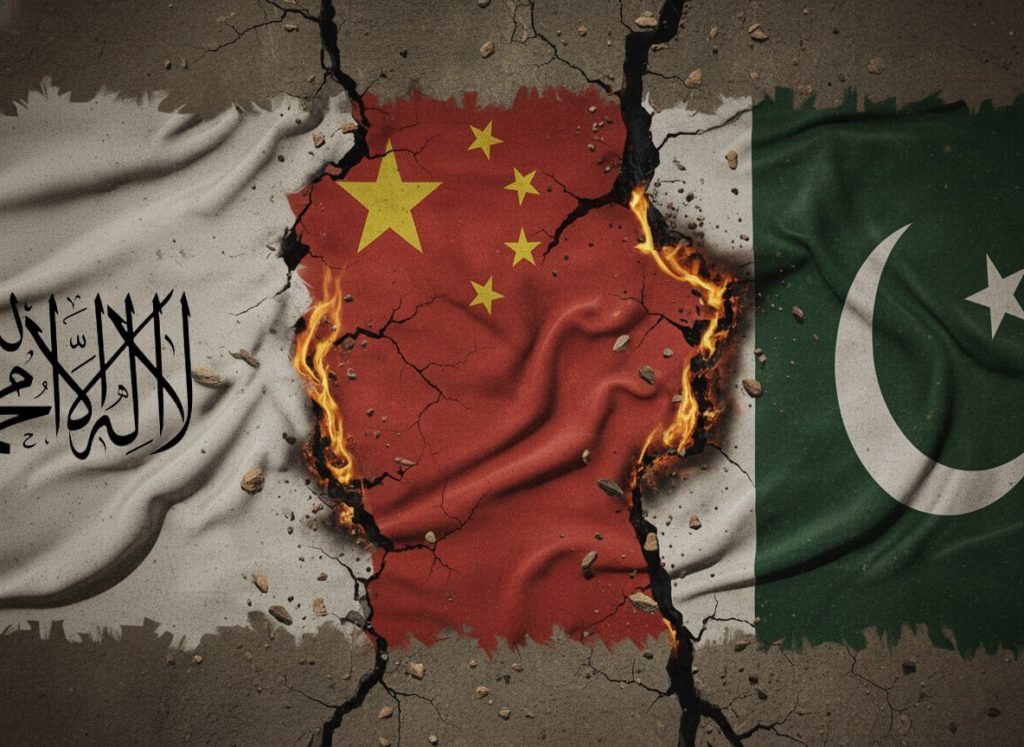
Now, as the flashpoint shifts from Iran’s border to Pakistan’s, Washington’s strategic map appears to be redrawn. The new line of tension stretches from the Persian frontier to China’s western edge — an emerging corridor of crisis that risks plunging all of Asia into prolonged disorder.
Iran and the Taliban: A Failed Project
Over the past two years, Western-aligned media outlets have amplified stories of water disputes and ideological rifts between Iran and Afghanistan. The narrative was clear: to draw Iran into an eastern confrontation that would dilute its strategic focus in the Persian Gulf and West Asia.
But Iran chose dialogue over escalation. Through direct diplomatic channels and careful control of public discourse, Tehran managed to defuse a potentially explosive situation. The result was a failed project — one that forced its designers, particularly the United States, to redirect their destabilization campaign toward Pakistan.
Pakistan: The New Proxy Battleground
The renewed clashes between the Taliban and Pakistan’s military are officially about border demarcations and the sheltering of militants. In reality, they mark the opening of a new and dangerous front.
Pakistan today faces a perfect storm: economic collapse, political polarization, and heavy dependency on Western financial institutions. It is precisely this combination that has historically enabled Washington to impose instability without direct intervention.
More importantly, Pakistan is central to China’s Belt and Road Initiative through the China–Pakistan Economic Corridor (CPEC). Any escalation along this axis strikes directly at Beijing’s strategic and economic ambitions — a blow fully consistent with America’s long-term objective of containing China’s rise.
China’s Encirclement Strategy
Since its military defeat in Afghanistan, Washington has abandoned direct wars in favor of what could be called “chaos management.” The approach relies on local crises to pressure major rivals without deploying U.S. troops.
For China, this strategy has created a ring of instability:
In the east, through tensions in Taiwan and the South China Sea;
In the north, via the protracted Ukraine conflict and pressure on Russia;
And now, in the west, through unrest along the Afghanistan–Pakistan border.
The logic is simple — geopolitical encirclement by proxy. Each local conflict chips away at regional stability, forcing Beijing to divert energy and resources to crisis containment rather than development.
The Taliban: From Actor to Instrument
Despite claims of neutrality, the Taliban have become entangled in this web. While seeking investment from China, dialogue with Iran, and contact with Russia, the group remains vulnerable to infiltration by extremist networks and Western intelligence interests.
If their conflict with Pakistan continues, the Taliban risk losing regional legitimacy and isolating Afghanistan from the economic frameworks of South and Central Asia.
The Bigger Picture
Washington knows the age of costly wars is over. Instead, it now exports instability — remotely and efficiently — through local actors who serve as geopolitical fuel. From the failed attempt to provoke Iran to the escalating clashes with Pakistan, the objective remains unchanged: weaken regional cooperation, contain China, and prevent the emergence of an independent Asian bloc.
What is happening today along the Afghanistan–Pakistan border is not a local dispute. It is part of a grander architecture of managed chaos — one drafted in Washington, but paid for by the people of Asia.
The future of stability in the region depends on whether Asian powers recognize this pattern and choose cooperation over confrontation. If they fail, the chain of crises — from Iran’s deserts to China’s mountains — will only grow longer and more dangerous.
By Rahel Mousavi