India Leverages Afghanistan as Strategic Gateway to Central Asia
DID Press: Reports indicate that Pakistan’s declining influence over Afghanistan trade and transit has created a new opportunity for India to rebuild its presence in Central Asia via western routes through Afghanistan, as Iran and Chabahar port serving as key pillars of this strategy.
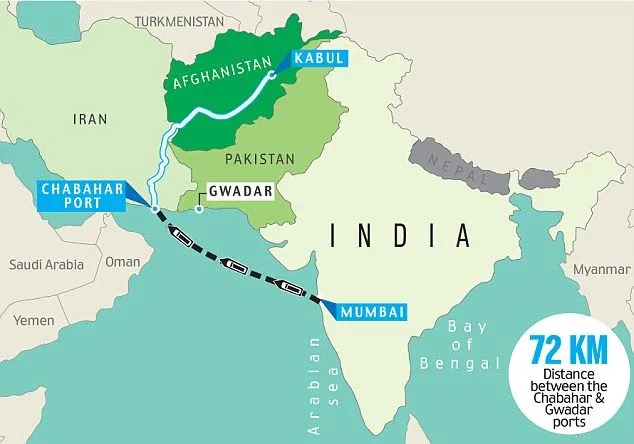
An analytical report published by The National Interest highlights that “Afghanistan’s trade and diplomacy are shifting in unexpected ways, reshaping regional geopolitical alignments.” The changes, particularly following the collapse of Afghanistan’s economic relations with Pakistan, provide India with an unprecedented chance to expand its influence in Central Asia via western corridors through Afghanistan.
According to the report, four years after India closed its embassy in Kabul, bilateral trade has nearly returned to pre-2021 levels, even amid Afghanistan’s disrupted trade via Pakistan. In the fiscal year 2023–2024, trade between India and Afghanistan reached $997.7 million, while Afghan exports to India generating a trade surplus for the first time. Key Afghan exports, including dried fruits, saffron, nuts, and apples, are now shipped to India duty-free.
In contrast, transit trade through Pakistan dropped from $7 billion in 2022 to $2.9 billion in 2024, following Islamabad’s anti-smuggling measures, stricter customs controls, and repeated border closures. Pakistan’s airstrike on Kabul in October and the visit of Taliban acting Foreign Minister Amir Khan Muttaqi to New Delhi reflect shifting allegiances and India’s strategic pivot westward.
The National Interest report also identifies Iran’s Chabahar port as a “pillar of India’s western strategy.” Managed by India and exempted from sanctions, the port has an 8.5 million-ton cargo capacity and serves as a vital route for exporting Indian pharmaceuticals, machinery, and vehicles to Eurasia. India has invested $120 million to upgrade the port’s infrastructure and provided a $250 million credit line to expand its capacity.
The report describes Afghanistan as “at the center of India’s western transit map and strategy.” Land routes through Herat and Turkmenistan provide direct access to Central Asia, while India’s Kazakhstan-Turkmenistan-Afghanistan (KTA) corridor is pursued both as an insurance route and a necessity to ensure reliable regional connectivity.
Analysts say India’s engagement with Afghanistan is more than tactical. It represents a broader strategic repositioning to counter regional encirclement by China while strengthening alliances with Afghanistan, Iran, and Central Asia—a logic aligned with the ancient Rajamandala theory of the Indian strategist Chanakya.