DID Press: The recent visit of Ahmad Shar’a — better known as Abu Mohammad al-Julani — head of Syria’s new interim government, to Washington marks a pivotal moment in reshaping the Middle East’s geopolitical balance.
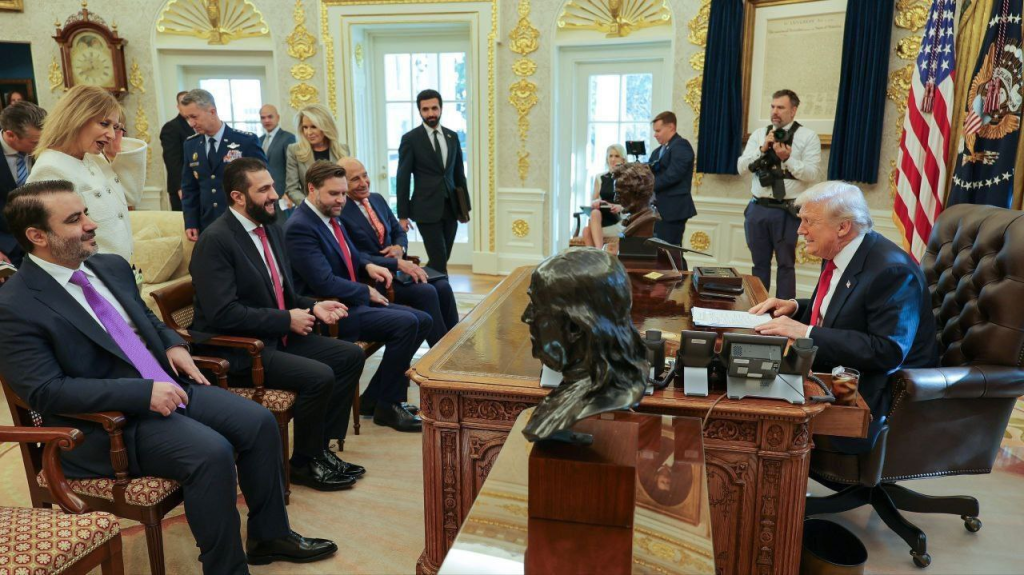
Although officially described as a step toward Syria’s participation in the “International Counterterrorism Coalition,” the trip reflects a deeper strategic alignment among Washington, Tel Aviv, and the post-Assad leadership in Damascus.
From Global Terrorist to U.S. Ally
Only a year ago, Shar’a appeared on the U.S. Treasury’s list of “Global Terrorists.” His sudden rehabilitation — followed by lifting of UN, EU, UK, and Turkish sanctions — signals a broader Western recalibration toward Syria after the collapse of the Assad Government.
Images of al-Julani in a formal suit alongside U.S. CENTCOM commanders have become emblematic of his transformation from insurgent to statesman — and of Washington’s new geopolitical orbit in the region.
A “Managed Peace” Strategy
Despite the official narrative of counterterrorism cooperation, analysts say the U.S. goal is to establish a “managed peace” in the region rather than a comprehensive resolution of conflicts. The approach mirrors the 1970s Egyptian-Israeli model — a fragile but sustainable order serving U.S. strategic interests.
One of the key discussion points in Washington, observers believe, was the groundwork for a de facto security arrangement between Damascus and Tel Aviv — potentially opening the door to a gradual normalization of relations.
Washington’s Three Strategic Goals
Analysts outline three primary U.S. objectives behind the new engagement:
- Neutralizing Iran and Hezbollah’s influence in Syria and severing ties between Damascus and the resistance axis;
- Consolidating Israel’s control over the occupied Golan Heights through tacit security guarantees from the new Syrian government;
- Restoring U.S. geopolitical primacy in a region increasingly influenced by Russia, China, and Iran.
In this sense, al-Julani’s presence in Washington was less an act of partnership and more a symbolic summons — a gesture of U.S. endorsement in exchange for Damascus’s strategic realignment.
Julani’s Bid for Legitimacy
For Shar’a, the visit is a lifeline. His administration faces severe economic hardship and craves international legitimacy. By seeking the repeal of the U.S. Caesar Act — one of the harshest sanctions packages on Syria — he aims to project the image of a pragmatic leader focused on reconstruction.
The Syrian leader is also attempting to exploit U.S. political divisions. While some Republicans, such as Lindsey Graham, have backed conditional sanctions relief, several Democrats see engagement with the new Syrian government as a chance to rebuild US leverage in the region.
High Risks, Uncertain Rewards
Yet Julani’s transformation remains fraught with peril. Deep mistrust persists both domestically and internationally. Any move toward Israel could ignite a backlash across the Arab and Muslim world, while alignment with Washington risks eroding Syria’s sovereignty.
The Bigger Picture
Julani’s Washington visit thus marks more than a diplomatic milestone — it represents the onset of a new phase of Middle Eastern realignment. Syria’s re-entry into global diplomacy may come at the cost of increased dependence on the United States and estrangement from Iran.
A man once branded a terrorist now walks the halls of the White House — a stark symbol of America’s fluid, transactional approach to regional politics. Behind the optics lies a shared ambition: to forge a new Middle East order where Israel’s security and Syria’s reconstruction are two sides of the same coin — a coin whose price the Syrian people may ultimately bear.
By Rahel Mousavi