DID Press: Senior US military officials identified South Korea as a key player in Washington’s efforts to counter China, a development that can reshape Seoul’s defense strategy.
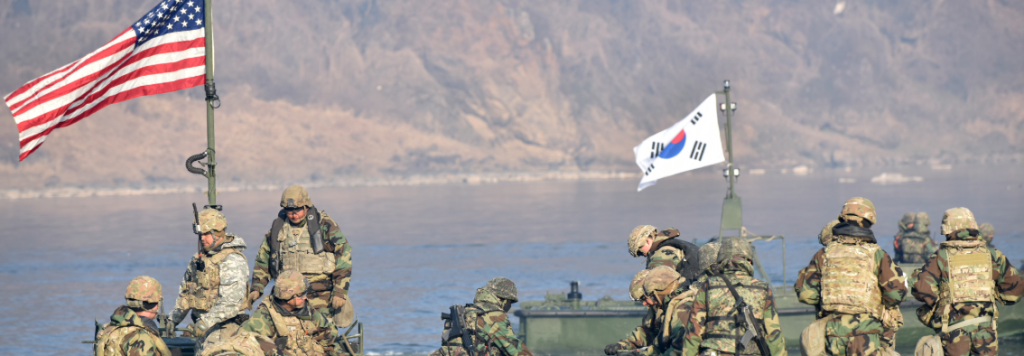
General Xavier Branson, commander of U.S. forces in Korea, on Monday called for a reassessment of South Korea’s geostrategic position, describing the Korean Peninsula as a “strategic pivot point.” He said U.S. forces stationed in South Korea operate “not as distant assets requiring reinforcement, but as forces embedded within America’s necessary defensive bubble.”
According to General Branson, the distance from Camp Humphreys to Pyongyang is approximately 158 miles, to Beijing 612 miles, and to Vladivostok roughly 500 miles. He emphasized that South Korea could deter threats from Russia while also countering Chinese activities in waters between Korea and China.
The remarks came two weeks after U.S. President Donald Trump agreed during a visit to Seoul to supply the country with offensive nuclear submarines, a capability South Korea has sought for more than two decades. Three days before Branson’s statement, Admiral Darryl Caudle, chief of U.S. Navy operations, visiting Korean shipbuilding facilities, said it is “natural” for the nuclear submarines South Korea will receive to play a role in joint efforts to counter China.
Traditionally focused on North Korean threats, South Korea’s military and President Lee Jae-myung’s government have also emphasized improving ties with China. The recent U.S. statements, however, have drawn attention and analysis in regional security circles.