South Asia Strategic Rift: Roots and Dimensions of Pakistan-Taliban Growing Tensions
Exclusive Report – DID Press: The relationship between the Taliban and Pakistan—once considered one of the closest yet most complex political and security partnerships in the region prior to 2021—has entered a phase many analysts now describe as a “structural distancing.”
What is unfolding between Kabul and Islamabad today goes far beyond a temporary disagreement or a border skirmish. A combination of historical, security, ethnic, geopolitical, and social factors has pushed relations into a state of deep mistrust. This report examines the key layers of this growing tension.
Historic Roots of the Dispute
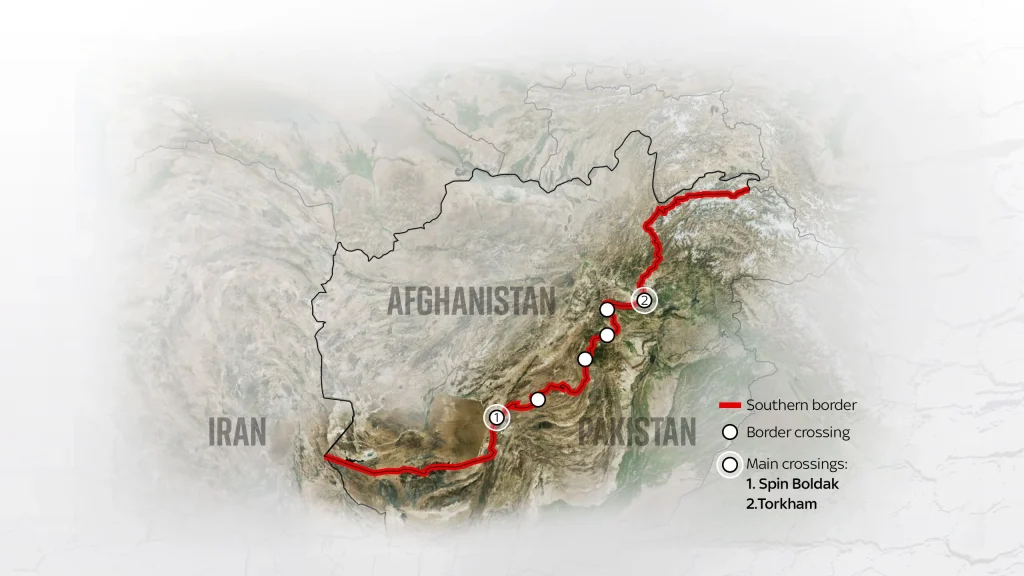
The long-standing dispute over the Durand Line, drawn by the British in 1893, remains the most fundamental source of friction between Afghanistan and Pakistan.
Successive Afghan governments refused to recognize the border, and the Taliban—now in control of Afghanistan—have upheld the same position. For many Taliban leaders and commanders, the Durand Line symbolizes not just a political boundary but the division of the Pashtun community.
Pakistan, however, considers the line a legitimate and final international border, viewing any challenge to it as a direct threat to its territorial integrity.
As a result, even minor incidents along the frontier quickly escalate, fueled by this deep historical identity-based dispute. The Taliban have repeatedly resisted Pakistan’s fencing operations and the construction of new border posts. This foundational disagreement has kept the rift permanently volatile.
Border and Security Tensions: From Sporadic Clashes to a Persistent Crisis
After the collapse of the former Afghan republic and the Taliban’s return to power, Pakistani officials expected increased border stability. Instead, the opposite occurred.
Today, the Afghan-Pakistani border is one of South Asia’s most volatile flashpoints. Key crossings such as Torkham and Spin Boldak have been repeatedly shut, border forces have exchanged fire on multiple occasions, and civilian infrastructure, markets, and property have sustained significant damage.
The Taliban, citing their historic stance, view Pakistan’s border activities as provocative, while Islamabad interprets the Taliban’s actions as a challenge to its sovereignty. This has transformed what was once a tactical dispute into a structural security crisis.
The Surge of TTP Attacks: The Core Driver of Escalating Tensions
No issue has strained Kabul–Islamabad relations more than the dramatic rise in attacks by Tehrik-e-Taliban Pakistan (TTP).
Since 2021, TTP assaults on Pakistani security forces have increased markedly, with several large-scale and coordinated operations. Islamabad accuses the Taliban of allowing TTP militants to use Afghan territory as a safe haven.
The Taliban deny the allegations, but the reality is that TTP fighters share deep social, tribal, and ideological ties with the Afghan Taliban. The Taliban lack both the political will and the strategic incentive to confront them decisively.
This has pushed Pakistan toward unilateral measures, including cross-border airstrikes—actions the Taliban condemn as violations of Afghanistan’s sovereignty. Consequently, TTP has become the central fault line and a major source of renewed mistrust.
Pressure on Afghan Refugees: A Human Crisis Turned Political Lever
Pakistan’s detention, restriction, and mass expulsion of Afghan refugees has become one of the most sensitive aspects of the current bilateral crisis.
Millions of Afghans sought refuge in Pakistan over the past four decades, becoming an integral part of the social fabric in many cities. However, recent Pakistani policies—ranging from home demolitions to forced deportations—have escalated tensions to a national and public level.
The Taliban call these measures inhumane and accuse Pakistan of using refugees as a political tool to pressure Kabul over TTP. Public sentiment inside Afghanistan has also sharply turned against Pakistan, further damaging societal ties.
Taliban’s Geopolitical Pivot: Strategic Diversification and Reduced Dependence on Pakistan
One of the defining trends in recent years is the Taliban’s multi-vector foreign policy, aimed at reducing historical dependence on Pakistan by strengthening ties with Iran, India, and China.
This strategic rebalancing has raised alarms in Islamabad.
- Growing Partnership with Iran
Driven by economic necessity and shared security concerns—especially in the fight against ISIS-K—the Taliban have expanded cooperation with Tehran. Afghanistan relies heavily on Iran for fuel, electricity, trade, and transit, and the Taliban use this relationship to counterbalance Pakistani pressure.
- Cautious but Purposeful Engagement with India
India was one of Afghanistan’s largest development partners over the past two decades. The Taliban see value in leveraging New Delhi’s economic capacity to reduce reliance on Pakistan, while India seeks to prevent Afghanistan from becoming Pakistan’s strategic depth.
- China’s Strategic Significance
China holds a uniquely important place in the Taliban’s calculations. With substantial investment capabilities in mining, infrastructure, and energy, Beijing offers the Taliban major economic opportunities. At the same time, China seeks stability on its western border and access to Afghanistan’s mineral wealth.
This multi-directional alignment has elevated the Taliban from a dependent actor to one with multiple regional partners—intensifying Pakistan’s strategic anxieties.
by Zahra Hussaini – DID Press Agency