New Revelations after 11 Years: Wahid Omar Claims Dr. Abdullah Won 2014 Elections
DID Press: For the first time, Wahid Omar, chief of staff to former Afghan president Hamid Karzai, claimed that Dr. Abdullah Abdullah was the true winner of Afghanistan’s 2014 presidential election. According to Omar, the results were changed due to U.S. intervention, specifically involving John Kerry, leading to the imposition of a political agreement that created the “National Unity Government,” a structure not envisaged in Afghanistan’s constitution.
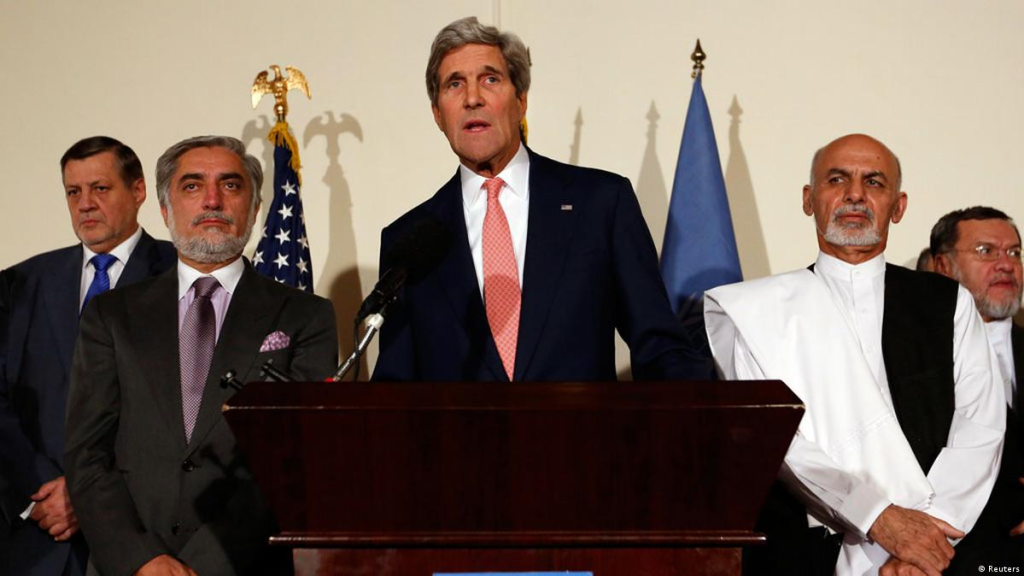
Omar, in his recent statements, shed light on one of Afghanistan’s most sensitive political episodes. He said that the real results of the 2014 presidential election showed Dr. Abdullah Abdullah as the victor, in an election that was marked by widespread disputes and unprecedented foreign intervention.
He also recalled that in the 2009 election, Hamid Karzai’s votes did not reach the “50+1” threshold, meaning a runoff was required, but the political process followed a different path.
Turning Point: John Kerry’s Arrival in Kabul
The 2014 election was one of the most controversial in Afghanistan’s history. In the first round, Abdullah Abdullah was ahead and widely considered the clear winner. However, after the second-round results were announced, Abdullah’s team alleged widespread fraud against Ashraf Ghani, halting the election process. The country faced a potential political crisis, with threats of a parallel government and deepening ethnic divisions, creating a highly tense political environment.
Amid this turmoil, John Kerry, then U.S. Secretary of State, visited Kabul in July 2014 and promoted a plan for a full vote recount under international supervision. This process led to a political compromise, establishing the “National Unity Government”: Ashraf Ghani as President and Abdullah Abdullah as Chief Executive—a position not defined in the Afghan constitution, created purely as an emergency measure to manage the crisis.
Criticism and Consequences
Although the agreement prevented political collapse, it faced widespread criticism. Many viewed it as clear evidence of U.S. interference in Afghanistan’s domestic affairs. Critics argued that Washington, by imposing a power-sharing model, ignored the will of Afghan voters and laid the foundation for an unstable system.
In the following years, the National Unity Government struggled with continuous internal conflicts between Ghani and Abdullah, alongside economic and security crises, increasing criticism of the way it was formed.
Reviving an Old Debate
Wahid Omar’s recent disclosure has reignited the debate over whether Dr. Abdullah truly won the 2014 election. Although no official confirmation was ever announced, the decisive role of the U.S. and John Kerry in altering the election outcome and shaping the political structure of that era remains one of the most sensitive points in Afghanistan’s contemporary history.