DID Press: A confidential U.S. Department of War report warns that, in the event of a military conflict with China, even advanced assets like the Ford-class aircraft carrier could be vulnerable, and the U.S. military may fail to defend Taiwan.
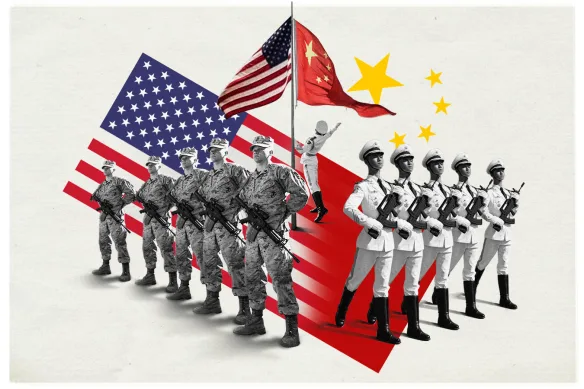
The “Overmatch Brief,” submitted to the White House in 2021, highlights serious vulnerabilities in potential scenarios involving confrontation with China. “For every defensive measure we’ve developed, the Chinese have repeatedly found counters,” underlined a senior Biden administration official.
The report focuses on high‑cost, advanced equipment, including the USS Gerald R. Ford, built at a cost of $13 billion, capable of carrying four fighter squadrons and approximately 5,000 personnel. Analysts warn that China’s arsenal of roughly 600 hypersonic missiles could target the carrier before it reaches Taiwan’s operational zone.
Despite these risks, the U.S. Navy plans to add at least nine more Ford-class carriers in the coming decades, while the United States has yet to deploy even a single operational hypersonic missile — a gap described by the New York Times as a “conceptual failure” in U.S. military strategy.
The confidential report underscores that U.S. strategy relies heavily on expensive and vulnerable assets, while major competitors like China and Russia focus on low-cost, high-tech weaponry. RAND Corporation argued in 2023 that “U.S. strategy and defense structure have become unsustainable,” with simulations showing traditional approaches may be ineffective against China and even Russia.
Simulations by the Center for Strategic and International Studies (CSIS) suggest that, with cooperation from Taiwan and Japan, the U.S. could repel a Chinese amphibious assault, but at very high human and financial costs. “In most scenarios studied, U.S. forces, alongside Taiwan and Japan, successfully countered China’s amphibious attack, but the success came at significant cost,” CSIS noted.