Revealed: US “Sunrise” Plan to Rebuild Gaza, From “New Rafah” to Smart City Vision
DID Press: A Euronews report reveals an ambitious, multi-phase and high-cost plan led by figures close to US President Donald Trump to comprehensively rebuild the Gaza Strip and transform it into a tourism and technology hub. However, implementation is conditioned on the complete disarmament of Hamas and the mobilization of international financing.
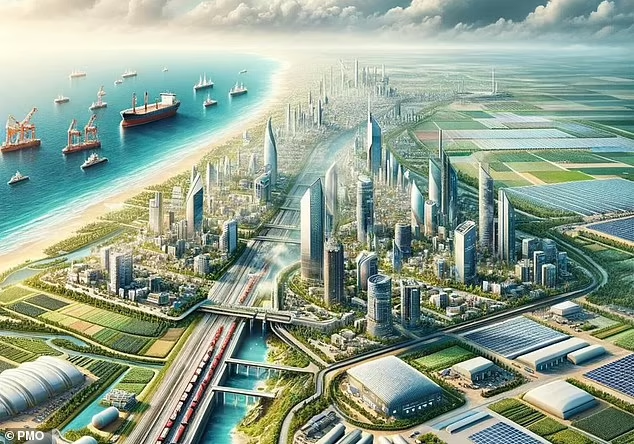
According to published reports, the Trump team has prepared a proposal known as the “Sunrise Project” aimed at the comprehensive reconstruction of Gaza, turning the enclave into a luxury and technologically advanced destination. The estimated cost of the ten-year plan is approximately $112.1 billion.
The proposal has been developed over the past 45 days by a team led by Jared Kushner, Trump’s son-in-law and senior adviser, and Steve Witkoff, US special envoy on Middle East. It has been presented in a 32-slide briefing marked “Sensitive but Unclassified” to potential financial backers, including some Gulf states, as well as Turkey and Egypt. Under the plan, the United States would commit $60 billion in initial funding, with additional costs to be covered later through Gaza’s internal revenues.
Previously promoted by Trump as creating a “Middle East Riviera,” the Sunrise plan is a four-phase, long-term program. The first phase focuses on clearing rubble, unexploded ordnance, and Hamas tunnels, alongside establishing temporary shelters and medical facilities. The second phase involves constructing permanent housing, public facilities, and infrastructure, with reconstruction beginning in southern Gaza—Rafah and Khan Younis—and gradually expanding northward toward Gaza City.
The third phase introduces a project dubbed the “Shining Riviera,” featuring luxury penthouse developments and advanced rail transport systems. In the final vision, a new city called “New Rafah” would serve as an administrative center, comprising more than 100,000 housing units, hundreds of schools, and cultural and healthcare facilities. Gaza City, meanwhile, would be transformed into a “smart city” powered by technology-based services. Planners estimate that 70 percent of Gaza’s coastline would be integrated into the economy, generating long-term returns exceeding $55 billion.
A key condition is explicitly emphasized in the plan: the complete disarmament of Hamas and the deactivation of all its tunnels. The United States and Israel have made the start of any reconstruction contingent on meeting this requirement—one that Hamas has so far rejected. US officials say that if security conditions are met, implementation could begin within two months.
The proposal has drawn mixed reactions. Some US officials doubt the feasibility of disarming Hamas and question whether countries would be willing to finance such a massive project. Others describe it as the most comprehensive and optimistic roadmap yet proposed for Gaza’s future.
The report’s publication coincided with Witkoff’s meetings in Miami with officials from Qatar, Egypt, and Turkey to discuss the second phase of the Gaza ceasefire. That phase includes an Israeli withdrawal, the transfer of Gaza’s administration to a temporary authority, and the deployment of an international force—progress on which has so far been slow.
Overall, the Sunrise plan presents an ambitious and costly vision for transforming Gaza, but its realization depends on overcoming major obstacles, including Hamas’s full disarmament, securing international investment, and stabilizing the fragile peace and ceasefire process.