Panjshir Emeralds: From Mines to Auctions, Taliban’s Growing Revenue Source
DID Press: Since the Taliban’s return to power, Panjshir emeralds have become one of the central pillars of Afghanistan’s natural resource extraction and sales. The holding of official auctions, the announcement of multi-million-dollar revenues, and repeated emphasis on the role of emeralds in the economy have raised serious questions about extraction mechanisms, sales transparency, and the real share of these revenues in the Taliban government’s income.
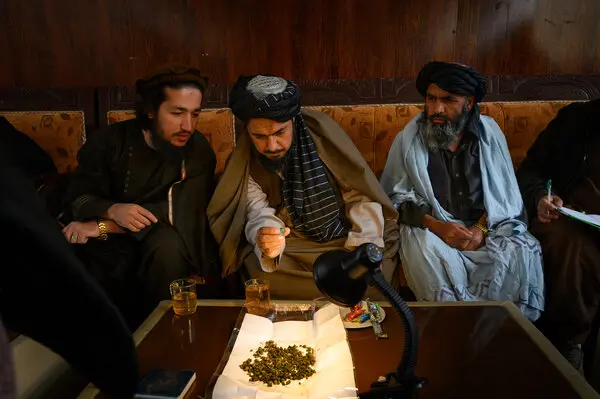
Since August 2021, the Taliban have repeatedly announced the sale of Panjshir emeralds through official auctions. The latest case involved the sale of 3,544 carats of emeralds extracted from Panjshir for a reported value of $3.644 million at a formal auction—figures that have once again drawn attention to the role of this precious stone in Panjshir’s local economy and in the Taliban’s revenue streams.
Panjshir emeralds are mined from the slopes of the Hindu Kush mountain range. According to research by the Gemological Institute of America (GIA), these emeralds share notable visual characteristics and chemical composition similarities with the renowned emeralds of the Muzo region in Colombia. The institute estimates that the known emerald-bearing area in Panjshir covers around 150 square miles, or nearly 400 square kilometers.
The Taliban-run Ministry of Mines has stated that approximately 1,700 emerald mines have been identified in Panjshir, of which up to 700 are active. Most of these mines are located east of the Panjshir River, with emeralds extracted from mountain veins and tunnels at high elevations. Local sources say the highest level of extraction takes place in Khenj district, where emerald mining has traditionally been an indigenous skill passed down among Panjshir residents.
However, reports indicate a strong and direct role for the Taliban in this process. Informed sources say emerald extraction is carried out under the direct supervision of Taliban military forces, while local residents are often employed as daily wage laborers.
According to these sources, workers are paid around 300 Afghanis per day, and the bulk of extraction operations is conducted by contractors with direct links to the Taliban.
They also say that less than half of the extracted emeralds enter official auctions, while the remainder is sold through opaque and non-transparent channels.
During the former republic, although emerald mining was initially disorderly, local community intervention and the introduction of regulations had significantly curbed illegal extraction. Today, local sources warn that Panjshir emeralds are being plundered and that, contrary to official claims, the industry has had little tangible impact on improving the local economy.
The Taliban’s focus on emerald sales can be understood within the broader context of the group’s need for financial resources. Credible international reports, including assessments by France 24 and the organization Afghan Witness, indicate that since returning to power, the Taliban have pursued mining as one of their primary sources of income.
Reports by the UN Secretary-General to the Security Council have also identified mining as a financial resource for the Taliban government, though they do not specifically name Panjshir emeralds.
From a value-chain perspective, Panjshir emeralds follow a complex path. Specialized assessments show that extraction begins on a small scale, followed by basic processing, entry into domestic markets, and eventual preparation for cutting, polishing, and export.
However, there is no precise data on the share received by local miners from the final global market price. The Taliban’s Ministry of Mines claims that 90 percent of auction proceeds go to miners, with 10 percent collected by the Taliban government as royalties—an assertion that is nearly impossible to independently verify.
Another area of ambiguity concerns pricing mechanisms at auctions. Official announcements typically disclose only the weight and total sale value, with no transparent information on base prices, buyer competition, or expert valuation prior to sale.
The absence of certified laboratory reports—an essential factor in determining emerald prices on the global market—represents another major gap in the process.
Reliable, up-to-date statistics on annual emerald production in Panjshir are also lacking. The most credible data dates back to 2009, when reports indicated direct employment for about 1,400 people across 172 active mines. Since 2021, reporting has focused more on sales figures than on the industry’s real impact on employment and local development.
In terms of quality, the Gemological Institute of America reports that Panjshir emeralds typically display a deep, vivid green color and include large crystal formations. Some scientific studies have even ranked these emeralds as comparable in quality and appearance to Colombia’s finest stones.
Overall, Panjshir emeralds today appear less a driver of local development than a source of revenue for the Taliban government. The lack of transparency in extraction, sales, and pricing—combined with the unclear share allocated to the local economy—raises serious questions about the future of one of Afghanistan’s most valuable mineral resources.