Removing Female Teachers and Deepening Education Divide in Afghanistan
DID Press: In absence of female teachers, many families are increasingly reluctant to send their children—especially girls—to school, a trend that has contributed to rising dropout rates.
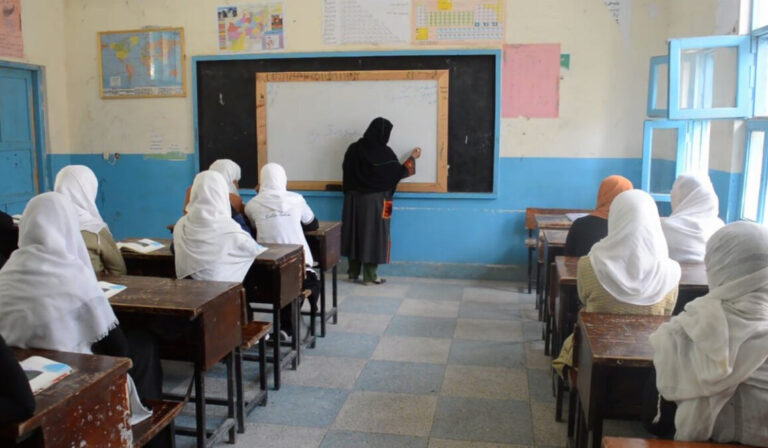
Afghanistan’s education system is facing one of the most critical crises in its history—a crisis rooted in the gradual removal of female teachers and sweeping educational restrictions. Recent assessments by the United Nations Children’s Fund (UNICEF) show that students’ learning outcomes improve significantly when teachers possess strong subject knowledge and university-level education. In Afghanistan’s current context, particularly with female teachers pushed out of classrooms, this principle has been largely ignored.
UNICEF has emphasized the crucial role female teachers play in improving educational outcomes, noting that investing in the training and employment of qualified women educators could significantly enhance learning quality in Afghan schools.
According to the organization, the presence of female teachers—especially at the primary level—not only raises academic standards but also creates a safer and more encouraging learning environment for girls. However, current restrictive policies have effectively removed this vital capacity from the country’s education system.
The scale of the crisis becomes even clearer when considering official data from UNICEF and UNESCO. Preliminary findings from a 2025 study indicate that approximately 93 percent of primary school students in Afghanistan are unable to read and comprehend simple texts. This alarming figure shows that the education crisis is not merely about a lack of schools or facilities, but about the quality of teaching and teacher capacity—an issue worsened by the exclusion of female educators.
At a time when education for girls above grade six has been banned, around 2.2 million girls have been denied their right to education.
This decision has not only destroyed the educational prospects of girls but has also triggered wider consequences for the entire education system. Excluding girls from schools has simultaneously led to the removal of female teachers, creating a vicious cycle that ultimately lowers learning quality for all students—both boys and girls.
Female teachers in Afghanistan play a role far beyond classroom instruction. They serve as social role models, psychological supporters, and cultural bridges between schools and families. Their exclusion has deepened educational and social divides and eroded equal learning opportunities. In the absence of female teachers, many families are less willing to send their children—particularly daughters—to school, further driving up dropout rates.
UNICEF stresses that strengthening teachers’ educational capacity is a cornerstone of building a sustainable education system in Afghanistan. Continuous teacher training, improved teaching skills, and providing suitable conditions for professional work are essential for delivering quality education. Yet the removal of female teachers and the neglect of professional teacher development have darkened the prospects for any meaningful educational reform.
Ultimately, the exclusion of female teachers in Afghanistan is not merely a discriminatory policy—it is a decision that systematically deepens the education gap. If this trend continues, future generations will face hidden illiteracy, entrenched inequality, and a loss of human development opportunities. The return of female teachers and investment in their empowerment is not a choice, but an unavoidable necessity to rescue Afghanistan’s education system.
By Sulaiman Saber – DID News Agency