DID Press: A recent NBC News report highlights growing concerns that escalating tensions between Iran, the US, and regional allies could spread to the Red Sea and the strategic Bab al-Mandeb Strait.
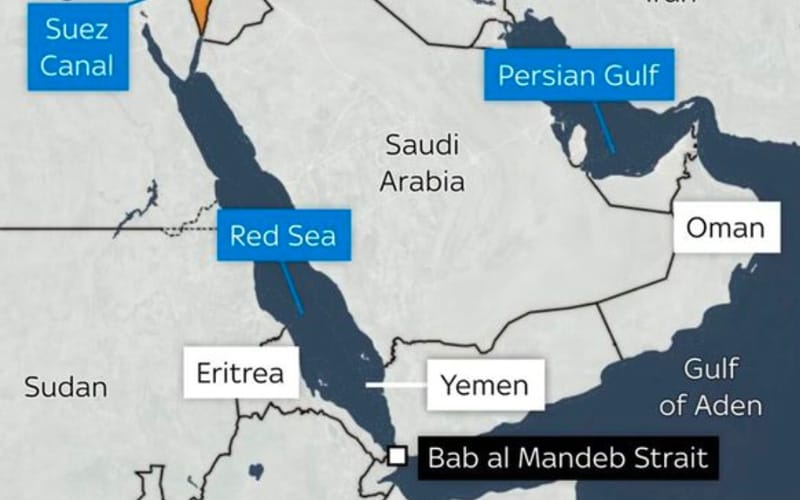
Iran has declared that the presence of the U.S. aircraft carrier USS Gerald R. Ford in the Red Sea makes it a “legitimate target,” warning that any supporting facilities could also be considered potential targets. It remains unclear whether Iran will directly attack shipping in the Red Sea.
Meanwhile, Yemen’s Houthi movement (Ansar Allah) has historically disrupted maritime traffic and could act as an operational arm for Iran. Houthi leader Abdul-Malik al-Houthi stated that his forces are “ready to respond at any moment,” though no new clashes have occurred so far. Experts note that while Ansar Allah acts independently, its threats alone have already disrupted global trade.
Oil and shipping markets have been volatile following U.S. and Israeli strikes on Iran, with the International Energy Agency calling it one of the most severe disruptions in oil market history. In response, Saudi Arabia has increased capacity on its East–West pipeline, and the UAE has strengthened flows via the Habshan–Fujairah pipeline. Analysts warn, however, that these alternatives can only replace roughly a quarter of the oil normally passing through the Strait of Hormuz and remain vulnerable to attacks.
Historically, the Red Sea and Bab al-Mandeb Strait carry about 10% of global seaborne oil. Houthi attacks since late 2023 have reduced oil transit through this route by 70%, forcing greater reliance on the longer Cape of Good Hope route and driving global commodity price increases. Experts warn that the Red Sea remains a convergence point for African, Gulf, Middle Eastern, Asian, and Western interests, making any escalation a serious threat to global shipping. Some analysts suggest that Ansar Allah’s restraint may be part of a phased Iranian strategy.