Moscow’s Economic Outreach to Kabul: Strategic Ambitions, Practical Limitations
DID Press: The recent visit to Kabul by Alexei Overchuk, Russia’s Deputy Prime Minister, leading a 70-member delegation of Russian businesspeople and company representatives, and the signing of 15 economic agreements worth $103 million have once again drawn attention to the future of economic relations between Moscow and the Taliban-led authorities.
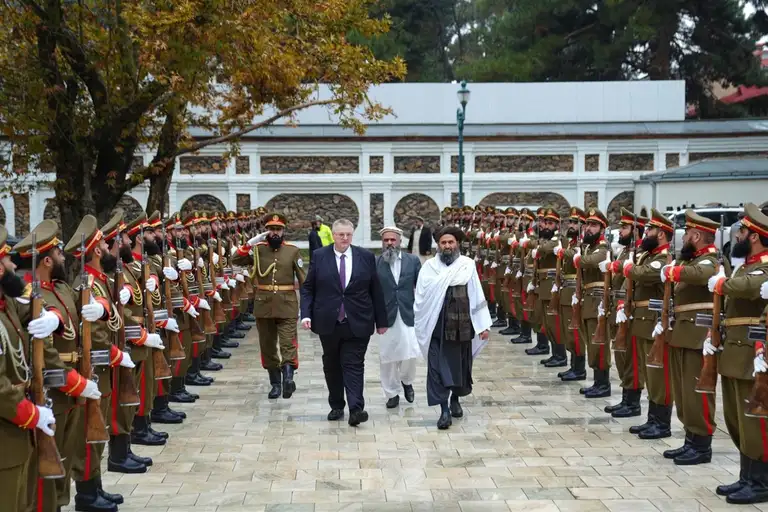
At first glance, this level of diplomatic and commercial activity, particularly following Moscow’s move to recognise Kabul, could be seen as a sign of a new phase in regional economic engagement. However, looking beyond the publicity and general official statements and examining the figures, the types of goods involved and the realities on the ground in both countries reveals a clearer and more realistic picture: rather than making a major push to rebuild Afghanistan’s infrastructure, Russia is pursuing a policy of cautious “trial and error” to assess the country’s market potential and transit routes.
The first indication of this pragmatic approach can be found in the figure of $103 million. In the context of regional economies, this amount represents neither a major investment breakthrough nor a level of trade capable of competing with the multi-billion-dollar exchanges that neighbouring countries such as Iran and China maintain with Afghanistan. The composition of the agreed trade also shows that cooperation is primarily focused on meeting everyday and basic livelihood needs. Afghanistan is set to import wheat, flour, cooking oil, medicine and chemical fertilisers from Russia in exchange for exports of dried and fresh fruits, vegetables and berries.
Although this exchange could be useful and necessary in helping Kabul manage its livelihood crisis and food security needs, it is essentially consumption-oriented and short-term in nature. It remains far removed from the vision of becoming a strategic partner in industrial development.
On the other hand, comparing the demands of the Afghanistanian side with the actual capacity of Russia’s public and private sectors makes the gap between ambition and reality even more apparent. Abdul Ghani Baradar, the Taliban-appointed Deputy Prime Minister for Economic Affairs, invited Russian companies during the meetings to invest in mining, establish special economic zones, build industrial factories and undertake major projects, including the construction of a second Salang Tunnel.
However, it should be remembered that Russia’s own economy has in recent years been grappling with the consequences of a protracted war, extensive financial sanctions and severe restrictions on the transfer of capital and technology. Under these circumstances, Moscow has neither substantial surplus financial resources to inject into high-risk and costly infrastructure projects in Afghanistan nor large companies willing to enter the market without firm banking and security guarantees. This is one reason why the memorandum of understanding in the energy sector was signed without the publication of any financial details or specific implementation commitments.
Despite these limitations, Moscow’s main motivation for sending the business delegation should be viewed in the context of changing regional geo-economic dynamics and pressure from Western sanctions. In an effort to overcome its commercial isolation from Europe, Russia urgently needs to activate the International North–South Transport Corridor and find alternative routes to access South Asian markets and open waters.
Overchuk’s explicit reference to Afghanistan’s potential to connect the northern and southern parts of Eurasia indicates that Moscow sees Afghanistan less as a major consumer market and more as a “transit bridge”. However, transforming Afghanistan into a secure and efficient regional transit hub requires standard railway and road infrastructure, refrigerated transport fleets, a banking system connected to the international financial network and lasting security stability. These conditions currently remain at a rudimentary level, and addressing them would require substantial investment over several years.
Overall, the renewed engagement between Kabul and Moscow can be viewed as a form of mutual convergence driven by necessity and pragmatism. Both governments face various international restrictions and sanctions and are seeking to open new channels for economic relief through direct trade.
For Kabul, these agreements represent a political achievement that can be presented as evidence of an end to its international isolation, as well as a means of securing some essential commodities.
For Moscow, the visit represents a low-cost, exploratory step to test Afghanistan’s business environment, establish direct links between business communities in the two countries and keep open the option of a southern transit route.
Therefore, unless Afghanistan’s financial, banking and transport infrastructure is modernised and lasting regional stability is established, Russia’s economic presence in Kabul is likely to remain limited to modest commercial exchanges and cautious experimentation.
By Sayed Baqer Waezi – DID News Agency