UN Resolution on Palestinian State: Document Affirming Legitimacy of Islamic Resistance
DID Press: Adoption of a draft resolution at the United Nations General Assembly calling for a two-state solution and the creation of an independent Palestinian state is, without doubt, a historic step in support of Palestinian rights and an acknowledgment of the legitimacy of resistance against Israeli occupation. Yet it comes tragically late, after decades of inaction and negligence by the international community and the UN itself. This long delay has not only deepened the suffering of Palestinians but has also cast serious doubt on the credibility and moral authority of the United Nations.
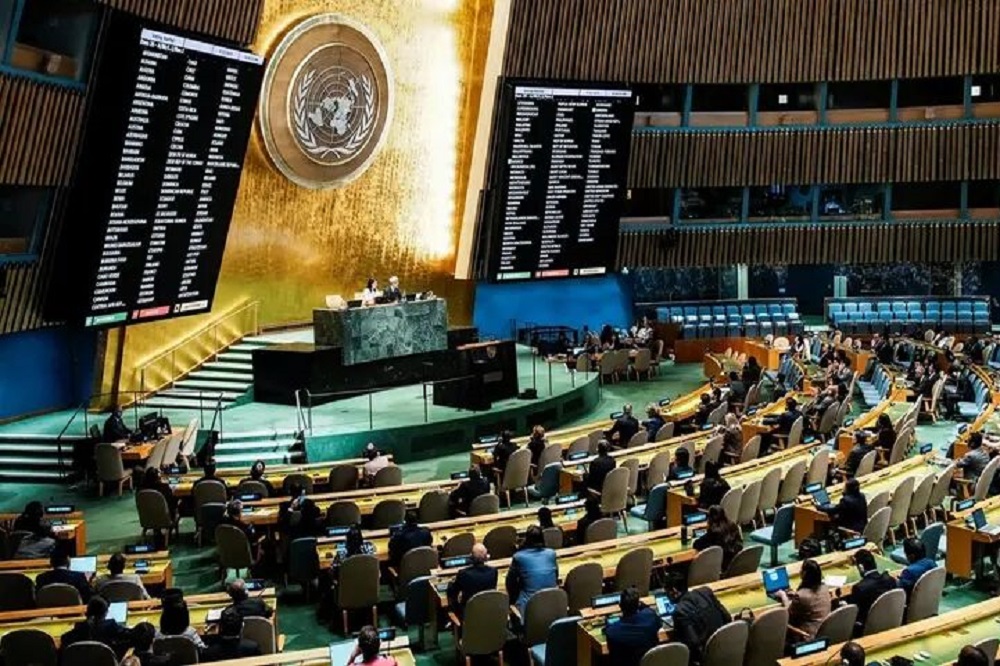
It must be remembered that the establishment of two separate states in the occupied territories runs counter to the historic aspirations of the Palestinian struggle and their legitimate demand for full sovereignty over their ancestral land. Palestine is, by right, the homeland of its indigenous people and must be liberated from occupation and returned to its rightful owners. Still, the mere fact that the UN—often seen as subservient to the United States—has passed a resolution recognizing an independent Palestinian state is, in itself, a meaningful achievement for the Palestinian cause and for the legitimacy of resistance.
One of the most notable aspects of the resolution is its reaffirmation of the principle of “two states living side by side,” a formula enshrined in multiple UN resolutions and international agreements for decades, though never pursued with seriousness or enforced in practice.
The passage of this draft demonstrates that global public opinion and the majority of UN member states continue, despite prolonged inaction, to support the historic rights of the Palestinian people. Yet a fundamental question remains: why has the international community failed to exert real pressure on Israel for so long? Why did it take decades of bloodshed, displacement, and oppression before even a symbolic draft resolution was passed? This negligence has compounded Palestinian suffering and squandered opportunities for peace.
Analysts argue that the resolution can have several important effects. Politically, it may increase international pressure on Israel to halt settlement expansion and violations of Palestinian rights. But the decades-long delay has sent Israel a clear message—that the world is mostly watching and rarely willing to act decisively. Psychologically, the resolution offers Palestinians and resistance movements renewed morale and confirms the legitimacy of their struggle. Yet this encouragement comes too late and cannot undo the immense damage inflicted over nearly eighty years of global hesitation.
The truth is that Israel’s unilateral and militaristic policies—expanding settlements, imposing a siege on Gaza, and curtailing Palestinian rights—have long been reinforced by the silence of the international community. While the passage of the draft carries symbolic and political weight, it cannot reverse the harm caused by UN inaction and global complacency. The long delay only deepens doubts about the international community’s genuine will to stand for justice.
At the same time, the resolution strengthens the legitimacy of Palestinian resistance. Whether through armed struggle, diplomacy, or international advocacy, resistance has been a lawful and moral response to occupation. Global hesitation has left resistance as the only effective option for Palestinians to defend their rights. Even if late, this resolution sends a clear message to the world: support for legitimate resistance and the Palestinian right to self-determination is inescapable.
In conclusion, the adoption of the UN draft resolution on the establishment of a Palestinian state is a necessary step toward justice and freedom. But its lateness has prolonged Palestinian suffering and exposed the international community’s failure to uphold human rights and the principles of international law.
By Mohsen Mowahed