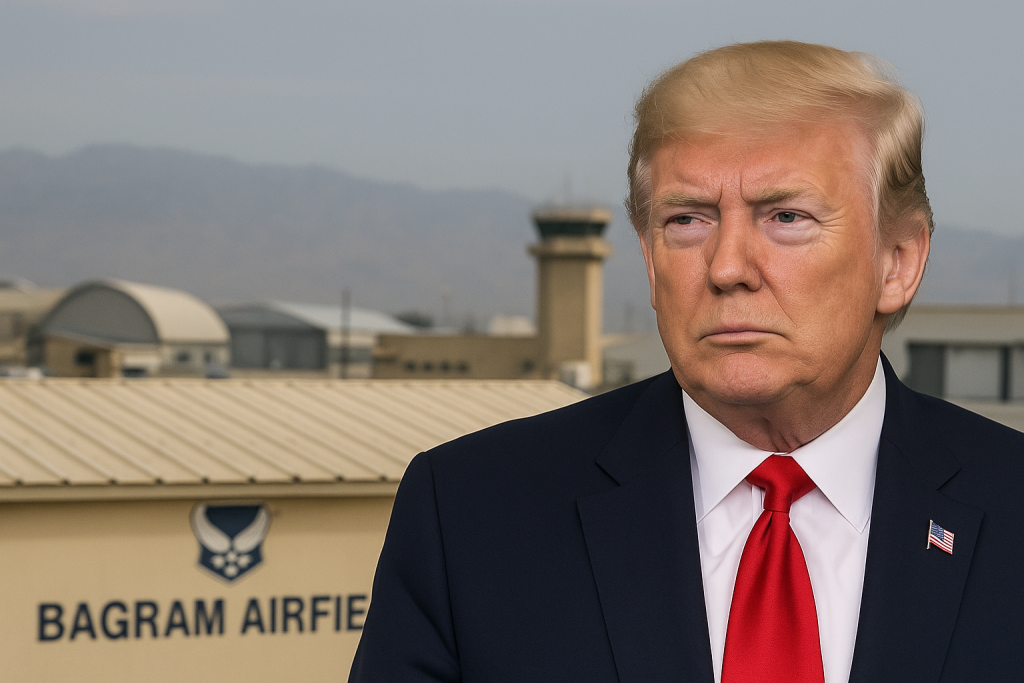
DID Press: US President Donald Trump’s remarks regarding potential reoccupation of Bagram Air Base mark a new phase in US policy toward Afghanistan, highlighting efforts to counter regional rivals while potentially threatening Afghanistan’s fragile stability and returning the country to the center of global geopolitical competition.
Experts on Afghanistan suggest that Trump’s comments should be understood as part of a broader U.S. foreign policy strategy, which can be analyzed in three stages:
Stage One: Withdrawal to Avoid Costs Benefiting Strategic Rivals
During his first term, Trump emphasized that the U.S. is not the “world’s police” and should not bear the costs of a war benefiting rivals such as China, Russia, and Iran. As a result, plans were made for U.S. forces to withdraw under President Biden. Washington expected that post-withdrawal, Afghanistan would descend into civil war and a weakened Taliban, but the rapid collapse of Kabul’s government and the Taliban’s return without combat created a new reality.
Stage Two: Containing the Taliban and Applying Economic Pressure
Following the withdrawal, the U.S. sought to limit Taliban consolidation. Key tools included freezing Afghanistan assets, refusing to recognize the Taliban government, and applying security pressures through groups like ISIS and sanctions on Taliban leaders. The goal was to prevent stability in Afghanistan, as stability would activate regional economic and geoeconomic channels benefiting China, Russia, Iran, and India. Despite these efforts, isolation was only partially effective, and regional powers began engaging extensively with the Taliban administration.
Stage Three: Returning to the Security Equation with the “Bagram Card”
Trump’s discussion of reoccupying Bagram represents the third phase of U.S. strategy. Reentering Bagram carries three implications:
Challenging the Taliban’s independence and weakening their internal legitimacy.
Re-securitizing Afghanistan, shifting it from an economic cooperation space to a security competition arena.
Pressuring regional rivals such as China, Russia, and Iran, who are investing politically and economically in Afghanistan.
Given the Taliban’s relations with Moscow and Beijing and domestic sensitivities regarding a renewed U.S. presence, implementing this plan in the short term is unlikely. Nevertheless, the discussion signals Washington’s intent: to reassert Afghanistan as a focal point of great power competition.
The analysis underscores that U.S. policy in Afghanistan has been driven more by geopolitical rivalry than by Afghanistan public interests, and any escalation of these tensions will impose greatest costs on the Afghanistan people and neighboring countries.
DID Press Agency – International Desk