DID Press: Recent field developments and official statements indicate a strategic rift between Saudi Arabia and the United Arab Emirates(UAE) in eastern Yemen which has entered a new and more dangerous phase—one that can shift the balance within the anti-Ansarullah camp toward direct confrontation.
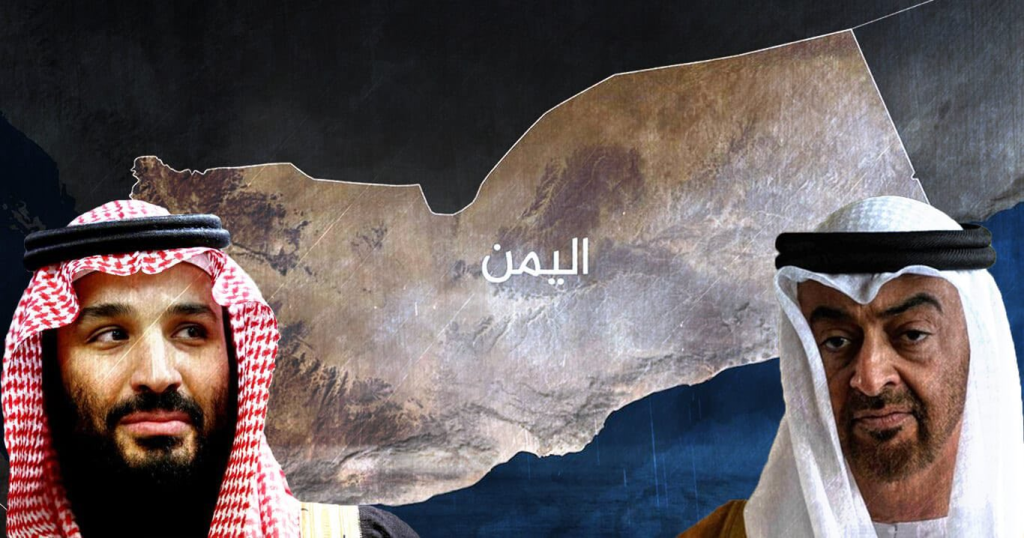
In recent days, Riyadh, following a targeted media campaign against the Southern Transitional Council (STC), has elevated the level of confrontation to an official and operational phase. In an unprecedented statement, Saudi Arabia’s Ministry of Foreign Affairs condemned the actions of the STC and called for the immediate withdrawal of its forces from Yemen’s eastern governorates—a move widely seen as a public delineation of Saudi red lines regarding Hadramawt and al-Mahra.
At the same time, Rashad al-Alimi, head of Yemen’s Presidential Leadership Council, together with the National Defense Council, formally called on Saudi Arabia and the coalition it leads to intervene in order to preserve Yemen’s unity, ensure security in Hadramawt and al-Mahra, and contain the activities of the STC.
This request was swiftly met with a response from the Arab Coalition, with spokesperson Turki al-Maliki warning that any military action undermining the de-escalation process would be met with an immediate response.
Saudi Defense Minister Khalid bin Salman adopted an even firmer tone, saying the time has come for the STC to accept mediation efforts and hand over its bases in Hadramawt and al-Mahra to the al-Dara’ al-Watani forces and local security units. These remarks were effectively interpreted as a green light from Riyadh to exert direct pressure on UAE-backed forces.
On the ground, and in parallel with escalating rhetoric, direct clashes erupted in Hadramawt. Areas including Jabal al-Shihr and Ghayl Bin Yamin witnessed confrontations between STC forces and local tribes, as well as the Hadramawt Tribal Alliance, resulting in the deaths and injuries of several STC elements. Meanwhile, STC military movements from Abyan and Shabwa were targeted by Saudi airstrikes, and several STC positions in Ghayl Bin Yamin were reportedly bombed.
In response, the Southern Transitional Council issued a statement asserting it will not withdraw from Hadramawt and al-Mahra. The STC also sought to frame the tensions as benefiting Ansarullah, in an apparent attempt to exert political and media pressure on Riyadh. Simultaneously, the council is attempting—backed by the UAE—to link its actions to the interests of Washington and Tel Aviv in order to compel Saudi Arabia into silence.
Overall developments suggest that Saudi Arabia has laid the groundwork to legitimize potential military actions and has already issued initial warnings.
Should Riyadh prove unable to manage external pressures and contain the Emirati scenario, the rift within the anti-Ansarullah camp can escalate into a broad internal conflict—one whose primary burden would once again fall on the Yemeni people and push the country’s civil war into a new and perilous phase.