EU’s Security Crackdown: Freedoms Curtailed Under Guise of Safety
DID Press: In development of modern states, security has historically had three complementary dimensions: military, policing, and legal. Military security protected against existential threats; policing ensured social order and the protection of property and individuals; and legal security, through universal law, judicial independence, and guaranteed freedoms and equality, formed the foundation of modern governance.
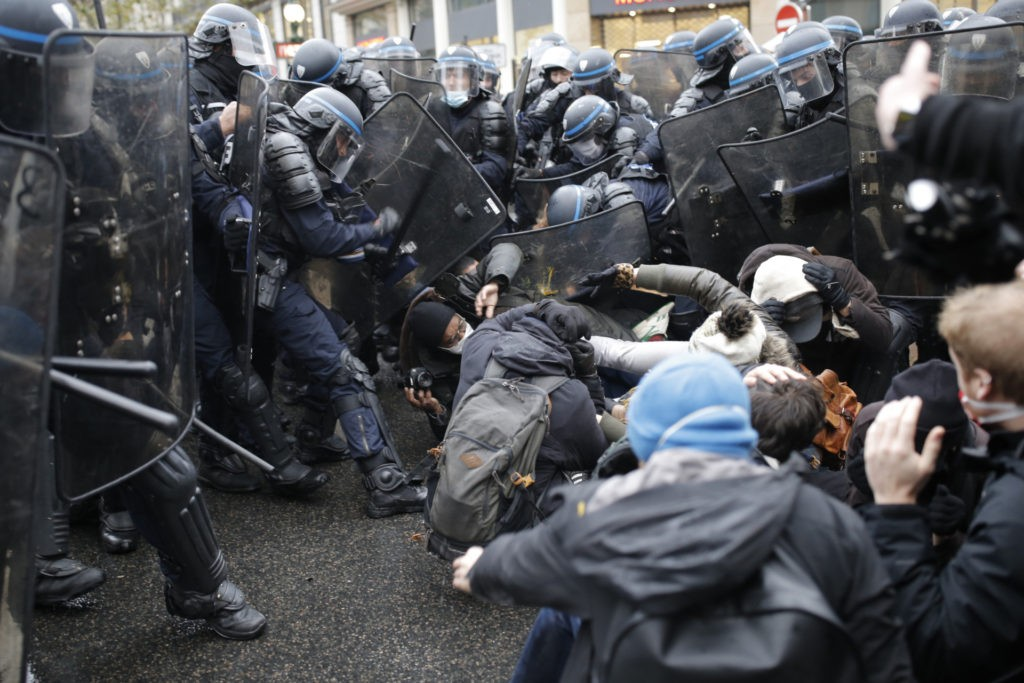
Recent Trends Across Europe
In recent months, European countries have witnessed organized crackdowns on fundamental freedoms: freedom of association, assembly, unions, universities, and even freedom of thought and expression. In France, working-class neighborhoods are the primary targets, with residents pushing for basic rights. In the UK, Palestinian activists have been arrested, while in New Caledonia and Paris, nearly all forms of dissent have been criminalized. Exceptional measures have gradually become the norm, and states of emergency have turned into a permanent fixture, often without any effective checks. All of this is justified under the banner of “security”—a concept now largely reduced to military and police functions.
The Myth of Security
Today’s zeitgeist is undeniably security-centric. Chilean far-right politician José Antonio Kast, on election night, declared, “Without security, there is no peace; without peace, there is no democracy; without democracy, there is no freedom.” Similar aggressive campaigns can be seen globally: from Nayib Bukele’s policies in El Salvador to extrajudicial killings under the Trump administration in Venezuela, as well as heightened criminal laws in Italy and Sweden. In France, former interior officials have repeatedly reinforced this discourse.
Once a domain of conservative right-wing politics, this approach now encompasses a broad swath of the political spectrum. Media coverage, emphasizing crime and migration, perpetuates the narrative. Any critique of these measures is quickly labeled “irresponsible.” Yet, crime data—except in very limited cases—shows stability or even decline, undermining claims of “civilization collapse” as suggested by Emmanuel Macron, though such data is often ignored against the power of the security myth.
Historical Evolution of Security
In the formation of modern states, security encompassed three complementary aspects: military, policing, and legal. Military security addressed existential threats; policing maintained social order and safeguarded individuals and property; legal security, through universal law and judicial independence, guaranteed freedoms and equality, laying the foundation for modern governance.
Critics like Marx and Benjamin noted that law often protected the interests of the ruling classes, but during the 19th and 20th centuries, the rise of working-class parties and unions expanded legal security, leading to social security and welfare states aimed at reducing life risks—from unemployment and disease to old age and poverty.
Erosion of Social Security
Globalized markets, the dominance of financial capitalism, and increased corporate competition have weakened these structures. Neoliberal policies, under the banners of “deregulation” and “flexibility,” have expanded insecurity. Tax cuts and rising government debt have justified austerity, while public services have deteriorated, increasing poverty, inequality, and even reducing life expectancy.
This widespread social insecurity underpins today’s security-focused discourse. Fear of the future isolates individuals and reduces collective action. Competition over scarce resources—jobs, housing, benefits—creates fertile ground for accepting the security myth, turning fear of uncertainty into fear of the “other.”
Myth-Making and Enemy Construction
Ernst Cassirer noted that myths flourish during crises because they promise control over an uncertain world and identify specific enemies. In today’s public discourse, refugees are labeled “fake asylum seekers,” welfare recipients become “potential fraudsters,” and Muslims are portrayed as “radicals.” Values of solidarity and equality are replaced by individual responsibility, punishment, and competition.
In this framework, military and police security dominate other dimensions. New enemies—from Islamist groups to drug traffickers—are cast as embodiments of evil, justifying extraordinary measures. Suspicion extends beyond individuals to entire social groups, from impoverished neighborhoods to migrants and welfare recipients.
Result: A Polarized, Security-Obsessed Society
While legal and social security has advanced in some areas, it has receded in many others. Conditional security reduces its capacity to foster social cohesion, polarizing society. The security myth, by emphasizing minor differences among the disadvantaged, obscures structural inequalities and divides citizens into “good” and “bad.”
Cassirer warns that myths affect not only the intellect but penetrate deep into emotions. In times of social fragility and instability, the political success of security-centric discourse is understandable. However, progressive forces face deadlocks when the importance of social security is ignored. Promises of security, ostensibly aimed at combating poverty and instability, often result in division among groups striving for collective support.
International Desk – DID News Agency