Saudi Company Signs Oil and Gas Deal with Taliban; Khalilzad Attends Ceremony
DID Press: Taliban administration has signed a contract with Saudi company Delta International for the exploration and extraction of oil and gas in the Kashk–Tirpul basin in western Afghanistan.
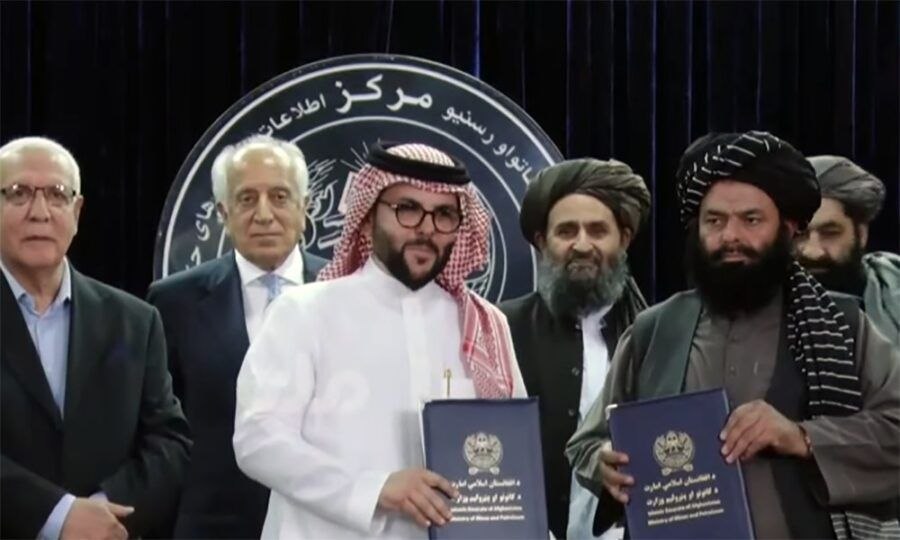
The agreement also covers the use of natural gas in Herat and the potential development of a regional pipeline, with former U.S. special envoy Zalmay Khalilzad attending the signing ceremony.
The oil and gas agreement between the Taliban’s Ministry of Mines and Petroleum and Delta International was signed in Kabul. Reports say the basin is located between Herat and Badghis provinces and covers an area of about 22,000 square kilometers.
Under the first phase of the project, the Saudi company will invest in exploration and extraction activities. The Taliban has put the potential total value of the project at up to $50 billion over a 25-year period.Khalilzad, the former U.S. special envoy for Afghanistan peace talks, described the agreement as “positive and promising.”
He said Afghanistan was ready to attract major international investment and, given its extensive natural resources and geopolitical position, could help meet the needs of regional and global markets.Khalilzad also said Afghanistan has the potential to become a “land bridge between Central and South Asia” and welcomed the agreement as an important development for the country’s investment prospects.
Khalilzad’s presence at the signing ceremony, given his central role in the negotiations that led to the 2020 Doha agreement, has again raised questions about his role in Afghanistan’s political developments and his engagement with the Taliban.
Meanwhile, Mawlawi Habibullah Hussam, head of the Scholars Committee of Afghanistan’s National Resistance Front, warned about the political and religious implications of recent developments.Hussam alleged that the Khatam al-Nabieen seminary and media outlets associated with Afghanistan’s Shia community had been taken over as part of a broader political strategy aimed at gaining the favor of the United Arab Emirates, Saudi Arabia and other regional actors.
He said the process would continue until Shia religious institutions and the community were weakened or eliminated.He also described the Taliban administration as “takfiri, proxy-based and fascist,” arguing that recent developments should not be viewed solely as internal Taliban actions but should also be examined in the context of wider regional political, social and religious dynamics.
Experts have also said Khalilzad’s presence at the signing ceremony adds to the political sensitivities surrounding the agreement, particularly given his role as the main U.S. negotiator with the Taliban and his involvement in the Doha agreement.
His performance during the process that culminated in the Taliban’s return to power has been the subject of strong criticism.Saudi Arabia’s history of engagement with the Taliban in the 1990s also means that Saudi investment in Afghanistan’s oil sector is unlikely to be viewed solely from an economic perspective.
The key question, therefore, is whether the agreement will be implemented as a transparent investment project based on Afghanistan’s national interests or become a vehicle for deepening ideological Wahhabi influence in the country.