Flag Present, Representative Absent: Pakistan’s Contradictory Hosting of ECO Summit
DID Press: A symbolic image at the 30th Meeting of the Council of Ministers of the Economic Cooperation Organization (ECO) in Islamabad has drawn the attention of observers: Afghanistan’s flag was prominently displayed alongside those of the other nine member states on the summit’s official banners, but the country’s seat in the meeting hall remained empty, and no invitation was extended to the authorities in Kabul.
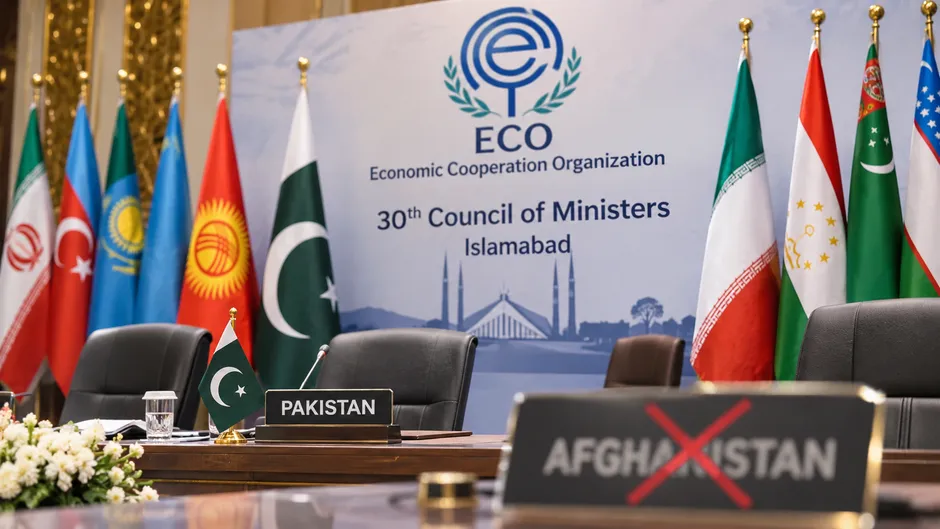
This apparent contradiction is more than a simple protocol discrepancy. It reflects the political tensions between Kabul and Islamabad and the complicated status of Afghanistan’s representation in regional institutions.
According to regional media reports and statements by Pakistani Foreign Ministry officials, Islamabad maintains that, under ECO’s agenda and procedures, representatives of Afghanistan’s caretaker government were not invited. Pakistan’s Foreign Minister Mohammad Ishaq Dar has also made regional cooperation conditional on action by Kabul against militants.
Critics, however, argue that Pakistan has used its position as the summit’s host and ECO’s rotating chair to pursue its bilateral security and border disputes with Kabul, effectively holding a multilateral economic organisation hostage to its political tensions with Afghanistan.
The criticism becomes more significant in light of the fact that, as Zakir Jalali, an official at Afghanistan’s Foreign Ministry, has pointed out, Afghan representatives attended the previous ECO meeting in Baku and are also expected to participate in a meeting in Tehran next month. This, critics argue, indicates that Kabul’s exclusion in Islamabad was not based on an established ECO legal rule, but rather on a unilateral decision by the host country.
From a legal perspective, Afghanistan has been a full member of ECO since 1992, and the organisation’s charter contains no mechanism for the unilateral expulsion of a member because of a change in its political system.
Islamabad was therefore required to retain Afghanistan’s flag as a formal member of the organisation, since removing it would have constituted an apparent violation of ECO’s rules. However, the absence of regional consensus on formally recognising the Taliban government has created a political and diplomatic vacuum: Afghanistan remains a legitimate member of the organisation, while its current government lacks an established status as its recognised representative.
This gap has allowed host countries such as Pakistan to impose political restrictions and prevent representatives from Kabul from entering the negotiating hall.
The greater contradiction in Islamabad’s policy becomes apparent when Pakistan’s stated theme for its ECO chairmanship — “Revitalising Regionalism” — and its efforts to connect Central Asia to open seas are considered alongside Afghanistan’s exclusion.
According to transit analysts, no overland road or railway route connecting Central Asia to Pakistani ports can bypass Afghan territory. Critics therefore argue that by sidelining Kabul and keeping border crossings closed, Islamabad is not only contributing to Afghanistan’s isolation but also undermining its own economic and transit ambitions. Such policies risk pushing regional traders towards alternative and more stable routes, including Iranian ports.
Moreover, the negative consequences of this security-driven and exclusionary approach directly affect Pakistan’s own economy. Border closures, obstacles to transit trade and restrictive policies towards Kabul are likely to harm Pakistani traders and exporters, who risk losing access to Afghanistan’s lucrative market and the wider Central Asian region.
Dissatisfaction within Pakistan’s private sector over the government’s approach is also reportedly growing. Business representatives understand that expanding exports and developing the ports of Karachi and Gwadar will remain unrealistic ambitions without Afghanistan’s active participation and uninterrupted access to regional trade routes.
Pakistani officials and supporters of Islamabad’s policies, however, argue that economic and transit issues cannot be separated from security realities, maintaining that continued insecurity and border clashes have undermined the trust needed for collective regional cooperation.
Nevertheless, developments on the ground suggest that maintaining the situation of “flag present, representative absent” will neither resolve security problems nor strengthen the effectiveness of organisations such as ECO.
Without Afghanistan’s participation and commitment, regional transit and customs initiatives are unlikely to move beyond declarations. Instead of serving as platforms for resolving crises, regional organisations risk becoming arenas where bilateral tensions are repeatedly reproduced.
Author: Sayed Baqer Waizi – DID Press