From Yemen to Kunar; Tracing Footprints of US and Saudi Weapons in Afghanistan
DID Press: The recent Pakistani airstrike on areas of Afghanistan’s Kunar Province should be examined as more than a military incident along the Afghanistan-Pakistan border. The remnants of the munitions used in the attack raise an important question about the origin of the weapons and the network through which they were transferred across the region. This question also brings the US and Saudi Arabia into the picture.
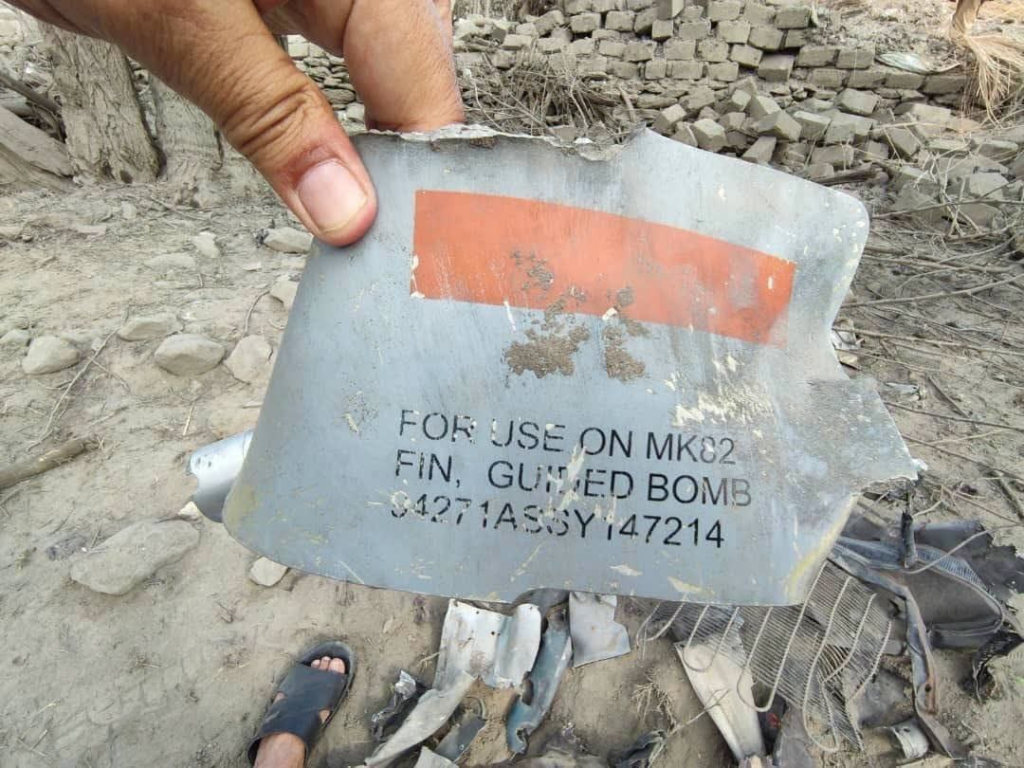
An examination of the markings on the remnants of the munitions indicates that an MK82 bomb was used in the attack, a type of bomb produced by the U.S. company Lockheed Martin. The significance of this lies in the extensive history of the same type of munition being used in the war in Yemen, while Saudi Arabia has for years been one of the major purchasers of U.S.-made weapons.
In one well-known case, the 2018 attack on a bus carrying schoolchildren in Saada, Yemen, was carried out with a U.S.-made MK82 bomb. Forty children were among the 51 people killed in that attack. Reports also indicate that the administration of Barack Obama at one point restricted the sale of such munitions to Saudi Arabia, but the administration of Donald Trump lifted those restrictions in 2017.
The more important question now concerns the place of these weapons within the region’s evolving security arrangements. Last year, Washington announced an approximately $143 billion arms agreement with Riyadh. At the same time, Saudi Arabia’s defense relations with Pakistan entered a new phase during 2025 and 2026.
From this perspective, the presence of an American-made MK82 bomb in the Kunar attack cannot be examined solely within the framework of a Pakistani military operation. Even assuming that the exact route through which the bomb was transferred has not been established, the reality is that the U.S. arms supply chain, Saudi Arabia’s military capabilities, and defense cooperation between Riyadh and Islamabad have formed an interconnected network.
The Kunar tragedy therefore presents a new picture of the spread of major-power weaponry across the region: a weapon of American origin, with a bloody history in Yemen, has now claimed victims in Afghanistan as well. Although determining the precise route through which the munitions reached Pakistan requires further documentation, the moral and political responsibility associated with the chain that places such weapons in the hands of regional actors remains a serious matter worthy of examination.
In this context, Saudi Arabia’s role cannot be excluded from the equation. Over the years, Riyadh has purchased large quantities of U.S. weapons and used them in the war in Yemen, leaving behind a dark and heavy record of deadly attacks against civilians. The expansion of defense cooperation between Saudi Arabia and Pakistan now reinforces concerns that an arsenal previously used against people in Yemen may have reached other conflict zones through regional security arrangements.
If Saudi Arabia played a role in transferring or supplying such weapons to Pakistan, its responsibility would not be limited solely to that of a seller and the user. Riyadh also have to answer for the humanitarian and political consequences of this weapons chain. Turning Saudi Arabia’s financial and military power into a means of strengthening military operations in neighboring countries not only makes regional security more fragile, but also demonstrates how the consequences of Riyadh’s arms policies can extend far beyond the borders of Yemen.