Multipolar World: A Chance for Global Justice or a Power Deal Over Humanity’s Future?
DID Press: The world today stands on the brink of one of the most significant geopolitical transformations of the 21st century. Competition among the United States, Russia and China, developments in the war in Ukraine, the Middle East crisis, the question of Palestine, tensions between Iran and the West, and shifts in economic and security dynamics all indicate that the traditional international order is facing profound challenges.
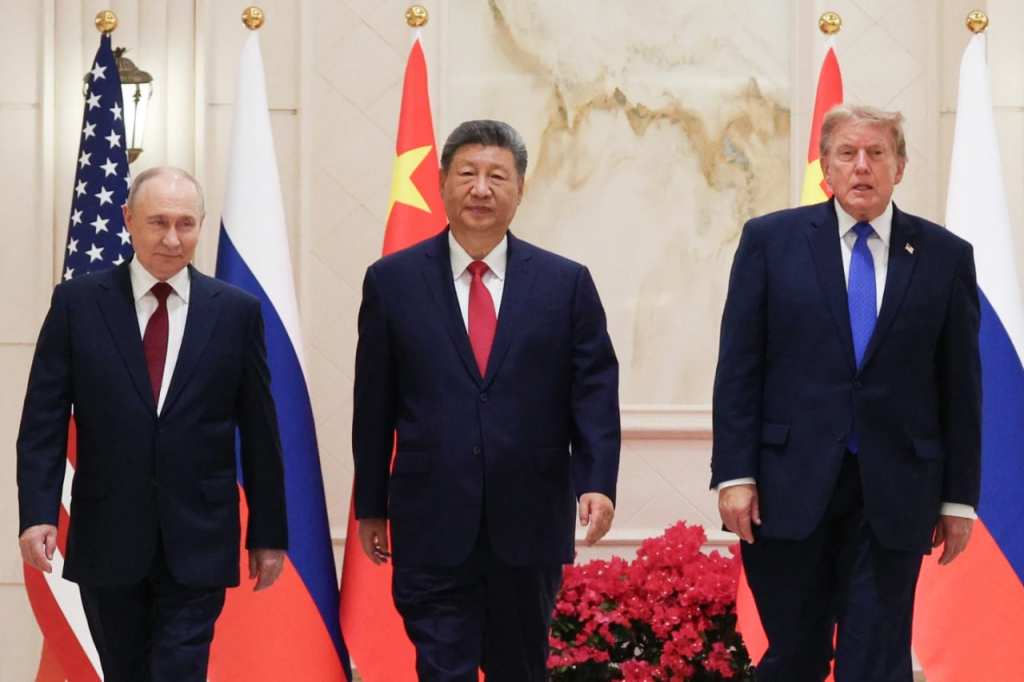
The meeting and discussions among the three major powers, regardless of their outcome, raise a fundamental question for the international community: Is the world moving towards the emergence of a fair, inclusive and multipolar order, or are major powers seeking to redefine spheres of influence and divide the world among themselves once again?
This question is not merely a diplomatic issue; it is directly connected to the fate of nations, the independence of countries, the security of future generations and the future of human civilisation.
1. A Multipolar World: The End of Monopoly or the Beginning of a New Rivalry?
China’s emergence as an economic and technological power, Russia’s continued strategic role in military and security affairs, and the United States’ efforts to maintain its global position indicate a gradual shift in the balance of power in the international system.
However, an important reality must be recognised: a multipolar world does not necessarily mean the achievement of justice.
If the monopoly of one power is replaced by the monopoly of three or more powers, the structure of domination has changed, but not its nature.
A multipolar world will be meaningful only when independent countries, developing nations and regional powers, including Islamic countries, have a genuine share in global decision-making, rather than having their destinies determined in closed-door negotiations among major powers.
No power should consider itself the owner of the world, entitled to decide the fate of nations or above the Charter of the United Nations.
2. Ukraine, Palestine and the Middle East: The Real Test of the Credibility of a New Order
Developments in Ukraine have demonstrated how competition among major powers can affect the security of an independent country and the stability of an entire continent.
Warnings about the possibility of an agreement between the United States and Russia over Ukrainian territory highlight a fundamental issue: no agreement concerning a country’s territorial and political future should be reached without the participation and consent of that country and its people.
In the Middle East, the situation in Palestine and Gaza is also a serious test of the credibility of international law and the responsibility of global powers.
It is impossible to speak of peace while remaining indifferent to the killing of civilians, the displacement of people, the destruction of vital infrastructure and violations of the fundamental rights of Palestinians.
Likewise, any escalation of military confrontation with Iran and the expansion of war across the region could expose energy security, global trade, the international economy and the stability of regional countries to far-reaching consequences.
The standard of justice must be the same in every crisis: in Ukraine, Palestine, Yemen and every other part of the world.
International law cannot apply one standard to the allies of major powers and another to their opponents.
3. The Historic Responsibility of the United States, Russia and China
The world’s three major powers, despite differences in their political systems, economic interests and geopolitical priorities, share a common responsibility: preventing competition among powers from becoming a threat to the survival of humanity.
The United States must recognise that global security cannot be guaranteed through unilateral pressure, extraterritorial sanctions and military interventions.
Russia must pursue its security concerns within the framework of respect for the sovereignty of countries and the principles of international law.
China, too, must demonstrate that multilateralism, respect for human rights, transparency, and respect for the religious and cultural rights of minorities are not merely diplomatic slogans, but principles that can be assessed and upheld.
None of these powers should consider itself exempt from accountability for the consequences of its policies.
The three powers are expected to take practical steps to curb nuclear weapons, reduce military tensions, end wars and strengthen international peace mechanisms instead of intensifying the arms race.
Real power does not lie in the ability to start a war; it lies in the capacity to prevent war and save human lives.
4. The Islamic World: From Spectator to Actor in the Future Global Order
One of the most important strategic questions of the present era concerns the position of the Islamic world in the future multipolar order.
With its large population, vast energy resources, strategic geopolitical position, economic potential and civilisational ties, the Islamic world could become one of the influential centres of the international system.
However, political divisions, intra-regional rivalries, economic and security dependencies, and the absence of a common strategy have prevented these capabilities from being transformed into effective global power.
The time has now come for Islamic countries to move away from fragmented and reactive policies and develop a common plan for their future.
This plan should be based on several priorities:
- Establishing collective security mechanisms and reducing differences among Islamic countries;
- Expanding economic, trade, energy and technological cooperation;
- Adopting a common and effective position on Palestine and the rights of peoples living under occupation;
- Increasing the role of the Islamic world in the United Nations and international decision-making institutions;
- Strengthening independent diplomacy and preventing Islamic countries from becoming arenas for competition among foreign powers;
- Supporting reform of the Security Council’s structure and increasing the representation of Islamic countries in the international system.
In particular, demanding reform of the veto system and establishing effective representation for the Islamic world on the Security Council should become serious diplomatic priorities.
The Islamic world should not merely respond when crises occur; it should also play a role in shaping decisions before crises emerge.
5. A Proposal for a Global Charter for a Just World Order
The trilateral meeting of the United States, Russia and China could provide an opportunity to advance a major international initiative: drafting a charter for cooperation among major powers in pursuit of lasting peace and security.
Such a charter should be based on the following principles:
- Respect for the independence, national sovereignty and territorial integrity of all countries.
- Preventing the instrumental use of sanctions, military threats and economic pressure against nations.
- Ending the nuclear arms race and establishing verifiable mechanisms for arms control.
- Ending wars and supporting political solutions based on international law.
- Preventing genocide, protecting civilians and guaranteeing humanitarian access.
- Reforming the structure of the United Nations and increasing the fair participation of independent countries in global decision-making.
- Combating poverty, energy crises, food insecurity and economic inequality.
- Respecting religious, cultural and ethnic diversity, as well as the fundamental rights of all human beings.
Such an approach could turn geopolitical competition into an opportunity for international cooperation.
Conclusion: The Fate of the World Must Not Be Monopolised by Major Powers
Today, humanity needs peace, security, justice and political rationality more than ever.
The world is exhausted by protracted wars, arms races, economic crises, military interventions and double standards.
The trilateral meeting of the major powers should be an opportunity to rethink the meaning of power and global responsibility, not a platform for dividing spheres of influence, bargaining over the territories of nations or consolidating political and economic monopolies.
The United States, Russia and China must understand that the greatness of a power is not measured solely by the size of its territory, military strength, nuclear arsenal or degree of economic influence. Rather, it is defined by the extent of its responsibility towards peace, justice and human dignity.
Meanwhile, the Islamic world and other independent countries must also move beyond exhausting divisions and work towards securing their rightful position in the future global order.
Our strategic message to the major powers is clear:
The world is not the exclusive property of any country. Security must not be monopolised by nuclear powers. Justice must not be subject to political considerations and the interests of powerful allies. No nation should become a victim of agreements reached behind closed doors.
We seek a world in which power entails responsibility, the sovereignty of countries is respected, the rights of nations are not sacrificed in political bargains, and the United Nations reflects the fair will of the international community.
History will honour the powers that saved the world from the threat of war and destruction, not those that reached agreements over how to divide it.
For the future of humanity does not depend on the number of powers dominating the world; it depends on the shared will of nations to build a freer, fairer and safer world.
A multipolar world must be a world of justice, participation and human dignity, not one of monopoly, domination and the division of power.
By Dr Abdulraouf Tawana | DID News Agency