EU Envoy: Technical Engagement with Taliban Does Not Constitute Recognition
DID Press: Thomas Frellesen, the European Union’s special envoy for Afghanistan, has said that the bloc’s recent contacts with Taliban officials have been strictly technical and operational and do not indicate any move towards normalizing relations or legitimizing the group’s administration.
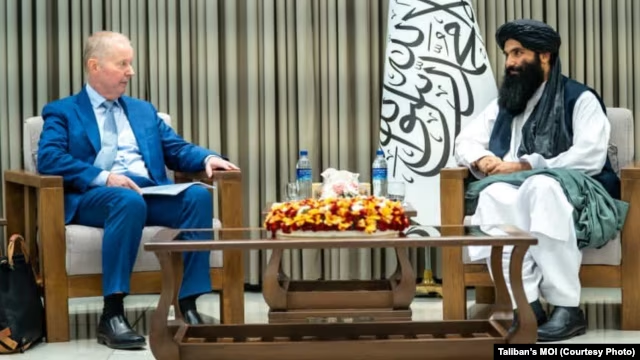
Frellesen, who took up the post in October, met with Sirajuddin Haqqani, the Taliban’s interior minister, in Kabul on October 12. In an interview with Radio Free Europe/Radio Liberty (RFE/RL), he outlined Brussels’ position on Afghanistan’s current challenges.
Women’s Rights and Humanitarian Aid Remain Top Priorities
Responding to criticism over the EU’s engagement with the Taliban amid increasing restrictions on Afghanistanian women, Frellesen said the situation of women and girls remained the bloc’s highest priority at both bilateral and multilateral levels.
He pointed to the EU’s role in advancing human rights resolutions on Afghanistan and establishing an independent investigative mechanism. He said he had also raised women’s rights as the first issue during his recent visit to Kabul and meetings with Taliban officials.
The Danish diplomat said the EU had provided more than €2 billion (approximately $2.2 billion) in assistance to the people of Afghanistan over the past five years. He added that all the assistance had been delivered in accordance with the principle of “by women, for women”.
Cooperation on Migration and the Return of Convicted Criminals
Referring to a Taliban delegation’s visit to Brussels in June, Frellesen said the meeting had been arranged at the request of several EU member states to establish a coordinated approach to the issue of migrant readmission.
He said the process concerned only individuals convicted of serious crimes or those considered security threats.
Responding to warnings by UN experts that the lives of some returnees could be at risk, Frellesen stressed that EU member states were required to comply with international law and the principle of non-refoulement, which prohibits returning people to places where they face a real risk of serious harm.
He described the number of people covered by the return arrangements as “very limited” and rejected any link between technical cooperation on migration and steps such as allowing Taliban officials to operate diplomatic missions in some European countries.
Concerns Over Rising Opium Production and Terrorist Threats
The EU special envoy expressed deep concern over a recent report by the United Nations Office on Drugs and Crime (UNODC), which found that opium production in Afghanistan had increased fivefold in 2026 compared with the previous year.
Frellesen said a ban on poppy cultivation alone was insufficient and that the Taliban, as the de facto authorities, needed to provide farmers with alternative livelihoods to safeguard their welfare.
According to UNODC’s 2026 survey, estimated opium production rose from around 300 tonnes in 2025 to nearly 1,500 tonnes in 2026. The agency also reported that cultivation expanded to more than 43,000 hectares.
Frellesen identified counterterrorism and preventing Afghanistan from becoming a safe haven for extremist groups as one of Brussels’ three main priorities.
Referring to the continued activities of Islamic State Khorasan Province (ISKP) and shared concerns with Central Asian countries and China, he said economic hardship created conditions that could make people vulnerable to recruitment by militant groups.
He also warned about border tensions between Afghanistan and Pakistan, expressing support for mediation efforts aimed at reducing instability in the region.