Pakistan UN Envoy Accuses Taliban of Destabilizing the Region
DID Press: Pakistan’s representative to the United Nations, Asim Iftikhar Ahmad, has expressed concern over the deteriorating security situation in the region, alleging that Afghanistan has once again become a safe haven for a number of terrorist groups and that the Taliban authorities are contributing to regional instability by supporting armed groups.
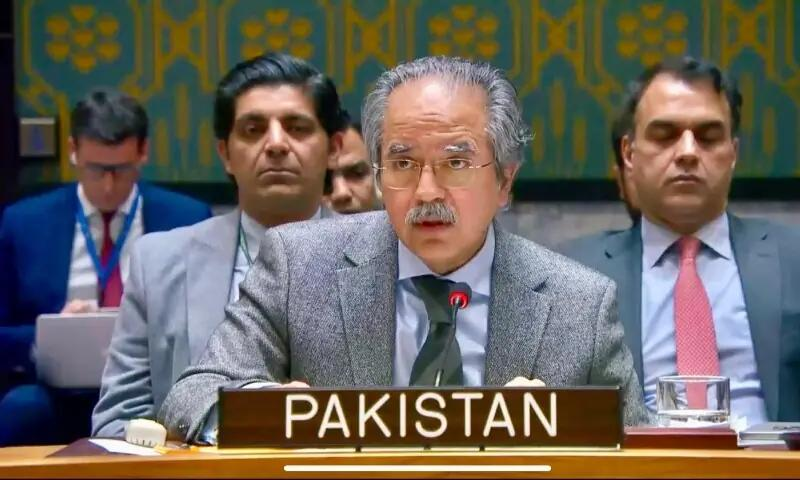
In an interview with Arab News marking the fifth anniversary of the Taliban’s return to power, Ahmad said Islamabad’s assessment of the Taliban government has steadily deteriorated since the group regained control of Afghanistan on August 15, 2021.
He stressed that Pakistan’s dispute is not with the Afghan people, saying the two neighboring countries have deep and longstanding ties and that Afghans have suffered the most from decades of war and instability.
Pakistan’s UN envoy said the international community had expected three key commitments to be implemented following the 2020 Doha Agreement and the Taliban’s return to power: the formation of an inclusive government, respect for human rights—particularly the rights of women and girls—and preventing Afghan territory from being used for terrorist attacks against other countries.
According to Ahmad, after five years, there has been regression rather than progress on all three fronts. He described restrictions on girls’ education and women’s employment as signs of deteriorating human rights conditions and characterized the Taliban’s governing structure as “exclusive.”
Ahmad added that Pakistan has paid the highest price in the fight against terrorism. He claimed that more than 5,200 terrorism-related incidents were recorded in Pakistan in 2025, resulting in more than 1,300 deaths. He acknowledged, however, that the figures cover a broad range of incidents and that not all cases have been independently attributed to attacks originating from Afghan territory.
He identified the Tehrik-e-Taliban Pakistan (TTP), the Balochistan Liberation Army (BLA), the Majeed Brigade and the regional branch of Islamic State as among the main groups responsible for the attacks, alleging that the first three operate extensively as “proxies for Pakistan’s regional adversaries.”
Asked whether the Taliban deliberately provide sanctuary to the TTP or lack the capacity to contain the group, Ahmad said the issue goes beyond a lack of capability or political will.
“The Taliban regime is in fact actively supporting it,” Ahmad said, alleging that such support includes safe havens, weapons and ammunition, some advanced equipment left behind by international forces, financial resources, assistance with planning and facilitating the movement of fighters across the border.
He further alleged that the Taliban have become a proxy force for destabilizing the region. The Taliban authorities have repeatedly rejected such allegations and have reaffirmed their commitment to preventing Afghan territory from being used against other countries.
Ahmad said the international community had provided the Taliban with sufficient opportunity and space since 2021, but, from Islamabad’s perspective, there had been no corresponding progress in forming an inclusive government, protecting human rights or combating terrorism.
Pakistan’s UN representative also referred to efforts by Muslim countries, including Pakistan, Indonesia and Saudi Arabia, to persuade the Taliban to reconsider their policies on women’s rights and girls’ education. He said the restrictions imposed on women were inconsistent with their interpretation of Islamic teachings and traditions.
He concluded that Western countries do not oppose the establishment of an Islamic system in Afghanistan in principle, but object to policies that, in his view, discriminate against women and minorities. He said addressing these concerns ultimately lies with the Taliban leadership.