Why China–Russia Partnership Is Strategic
DID Press: As Russian President Vladimir Putin travels to Beijing on the anniversary of a key bilateral cooperation treaty, assessments indicate that the China–Russia partnership is increasingly shaped by geopolitical imperatives, economic interdependence, and shared responses to U.S. pressure—factors that sustain an asymmetrical yet stable relationship.
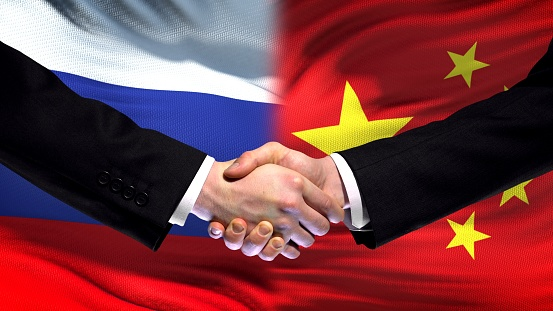
Putin’s visit highlights renewed attention on the true nature of Moscow–Beijing relations, which both sides describe as a “no limits partnership.” In practice, however, the relationship is built on geopolitical necessity, economic reliance, and strategic security considerations. The timing of the visit—coinciding with the 25th anniversary of the Treaty of Good-Neighborliness, Friendship and Cooperation—comes shortly after Beijing hosted U.S. President Donald Trump, adding sensitivity to China’s balancing act between Washington and Moscow.
Analysts say the structure of the relationship has become increasingly unbalanced, with China emerging as the dominant partner. According to Alexander Gabuev of the Carnegie Russia–Eurasia Center, Western sanctions have pushed Russia into deeper dependence on Chinese technology and finance, with many agreements now effectively shaped by Beijing’s conditions. China is Russia’s largest trading partner, while Russia accounts for only around 4% of China’s external trade.
Since the Ukraine war, Russia’s reliance on Chinese components and technology has surged, with reports suggesting that over 90% of sanctioned technologies entering Russia are routed through China. Chinese firms such as Huawei have filled gaps left by Western companies in the Russian market.
Energy cooperation remains the backbone of the partnership. Russia is a key supplier of oil and gas to China, and major projects such as the “Power of Siberia 2” pipeline—expected to transport 50 billion cubic meters of gas annually via Mongolia—are further deepening strategic ties. Amid tensions in the Strait of Hormuz, China is also seeking to diversify away from risky maritime routes by expanding energy imports from Russia.
Despite this closeness, experts stress that the relationship is not a formal military alliance. Former diplomat Bobo Lo notes that flexibility is a key factor in its durability. While both countries share opposition to U.S. global dominance and Western political pressure, they maintain strategic autonomy. China has taken a cautious stance on issues such as the Ukraine war while keeping diplomatic channels open with the U.S. and Europe.
On the political level, personal ties between Xi Jinping and Vladimir Putin have strengthened the partnership. Putin has visited China more than 25 times, and both leaders frequently refer to each other as close friends. However, cultural affinity between the two societies remains limited, with many Russians still favoring European cultural preferences.
Despite structural imbalances, analysts see no immediate signs of decline in the partnership. Shared borders, complementary economic interests, and mutual resistance to Western pressure continue to bind the two powers, making the relationship strategically indispensable for both sides.
By Sayed Reza Mousavi | DID News Agency