DID Press: Iraq’s holy cities of Karbala and Najaf, long regarded as the spiritual heart of Shia Islam, are increasingly attracting visitors beyond the Muslim world. While some scholars question whether widely circulated images of Christian participation in the Arbaeen pilgrimage reflect a broader sociological reality, documented accounts from clergy, public officials, artists, and pilgrims indicate that a number of non-Muslims have taken part in the pilgrimage, viewing Imam Hussein as a universal symbol of justice and human dignity.
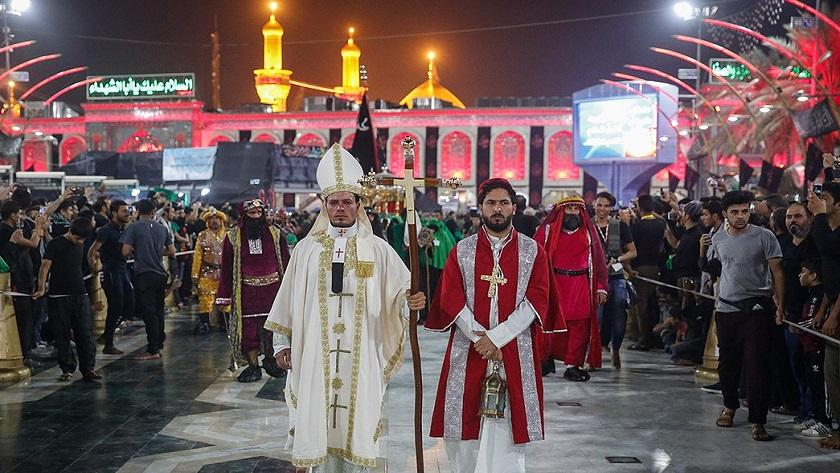
According to the report, recent years have seen growing attention on the participation of followers of other faiths—particularly Christians—in religious ceremonies and pilgrimages to the holy shrines in Iraq. Images of priests in clerical robes and pilgrims carrying large wooden crosses among millions of Arbaeen participants have circulated widely on social media.
However, Gabriel Said Reynolds, a prominent scholar of Islamic studies, has urged caution in interpreting such images. He argues that the scenes do not necessarily demonstrate widespread Christian participation and may instead represent elements of religious performance or symbolic reenactment. Reynolds, drawing on revisionist scholarship, says further field research and documentary evidence are needed before definitive conclusions can be reached.
Despite that skepticism, several documented examples suggest that non-Muslim participation is genuine in at least some cases. Malkhaz Songulashvili, who joined the Arbaeen pilgrimage in 2018, described the experience as far more than a religious visit. He said that although the event commemorates the martyrdom of Imam Hussein, it ultimately represents a triumph of justice, adding that Hussein belongs not only to Shia Muslims but stands as a universal symbol of justice, compassion, and human solidarity. He also praised the hospitality shown by pilgrims along the route.
The report also points to official-level participation. Evan Faeq Jabro, a Chaldean Christian, visited the holy shrines in Karbala alongside other Christian participants in 2024. His visit was presented as reflecting both Iraq’s national identity and shared cultural heritage, where historical geography and religious symbolism intersect.
In another example, a delegation from St. Mary Church of Baghdad, led by Father Martin Beni, traveled to Karbala in May 2017 in response to Easter greetings previously extended by Shia youth, promoting a message of peace and coexistence.
The report further highlights the experience of Italian Christian photographer Claudia Borgia, who documented the Arbaeen pilgrimage after attending in 2013. Having captured around 6,000 photographs, she later organized an exhibition in Rome and described herself as an “ambassador of Arbaeen,” saying her work aimed to portray resilience—particularly that of Zaynab bint Ali—without prejudice.
On a more personal level, Irish pilgrim Tara O’Grady said she traveled to Karbala in 2018 because she wanted to see “the water that Imam Hussein was denied,” describing her journey as a deeply personal and spiritual experience.