Exclusion of Persian on Official Signboard: Negligence or Linguistic Bias?
DID Press: In multilingual societies, symbols carry significance beyond their appearance. An official welcome sign is not merely a greeting; it reflects which groups are visible in the public sphere and which are less formally recognized. For this reason, the omission of a language can be interpreted as a sign of inequality or neglect, fueling broader debates on linguistic and cultural justice.
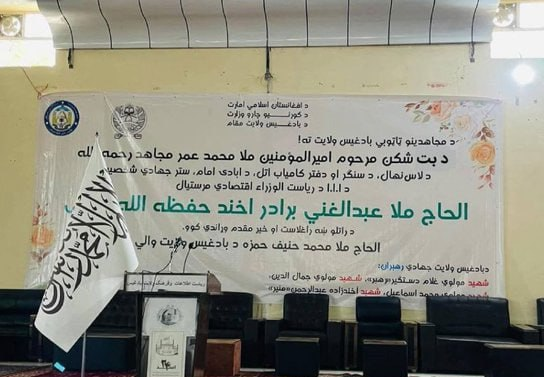
The unveiling of a welcome sign for Mullah Abdul Ghani Baradar, Deputy Prime Minister for Economic Affairs of the Taliban administration, in Badghis province has sparked public debate due to the absence of the Persian language. In a country like Afghanistan, where language is deeply intertwined with politics, identity, and power structures, the exclusion of a language from an official symbol is rarely seen as accidental and is often interpreted beyond a simple administrative error.
At first glance, the incident could be attributed to negligence or administrative shortcomings. In many cases, the design and installation of official signage are delegated to mid-level or local authorities, and lack of oversight or sensitivity to linguistic considerations may result in the unintentional omission of a language. From this perspective, the issue reflects less a deliberate policy and more a failure to recognize the importance of symbolic representation in a multilingual society.
However, the timing of the incident during a formal ceremony attended by a senior political figure raises the possibility of linguistic bias or intentional prioritization. In such events, details are typically carefully managed, and language selection in official texts forms part of the symbolic representation of authority. From this angle, the omission of Persian may be interpreted—whether intentionally or not—as an indication of linguistic hierarchy or a redefinition of official symbols.
The significance of the issue becomes clearer when considering the status of Persian (Dari) in Afghanistan. It is not only one of the country’s official languages but also widely used in daily communication, culture, and administration in many regions, including Badghis. Therefore, its exclusion from an official sign can create the perception among segments of society that their linguistic identity is being marginalized or overlooked. Even if unintended, such perceptions can have tangible social consequences.
In multilingual societies, symbols carry meaning beyond their visual form. A welcome sign is not merely informational; it reflects which communities are recognized in public life. As such, the omission of a language may be perceived as inequality or disregard, potentially fueling wider discussions on cultural and linguistic fairness.
Reactions to the incident indicate that society is highly sensitive to such seemingly minor issues. This sensitivity stems from historical experiences and the central role of language in shaping collective identity. If repeated or left unaddressed, such incidents may deepen mistrust among different communities and widen social divisions.
Ultimately, whether the absence of Persian on the signboard was due to negligence or reflects a deliberate orientation remains unclear without official clarification. What is clear, however, is the importance of managing official symbols carefully in a diverse society. If the goal is to preserve social cohesion and respect cultural diversity, greater attention must be paid to the design and implementation of such symbols to ensure that no segment of society feels excluded or unrecognized.
By Sayed Baqer Waezi | DID News Agency