Russia Moves to Consolidate Taliban Power Through Military-Technical Cooperation Deal
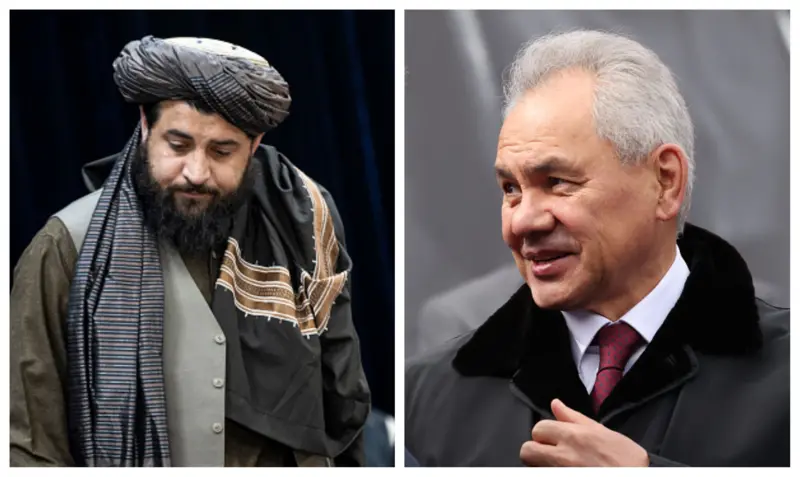
DID Press: A newly signed military-technical cooperation agreement in Moscow between Sergey Shoigu, Secretary of the Russian Security Council, and Mullah Yaqoob Mujahid, Taliban’s Defense Minister, signals a notable strategic shift in Russia’s approach toward Kabul. The agreement reflects a transition from crisis management and limited diplomatic engagement toward structured security cooperation with far-reaching geopolitical implications.
A Shift Toward Structured Security Partnership
The agreement, accompanied by intensive meetings between Afghan and Russian defense officials, suggests that Moscow is recalibrating its Afghanistan policy toward a more pragmatic, security-driven engagement model.
Rather than treating Afghanistan solely as a crisis zone, Russia increasingly views the Taliban as the dominant on-the-ground authority capable of enforcing stability and suppressing transnational militant threats such as ISIS-Khorasan.
This shift effectively elevates engagement from dialogue-based diplomacy to operational-level military cooperation.
1. Regional Security Architecture and Outsourced Stability
From a regional security perspective, Russia’s primary concern remains the spillover of instability into Central Asia, particularly terrorism, narcotics trafficking, and extremist mobility across southern borders.
Moscow’s growing engagement reflects a calculation that the Taliban, despite ideological differences, represent the only coherent force capable of exerting territorial control in Afghanistan.
In this context, military-technical cooperation can be interpreted as a form of “outsourced regional stabilization,” where Russia supports Afghan security capabilities in exchange for de facto legitimacy and border stability assurances.
2. Military Modernization and Dependence on Russian Systems
A key dimension of the agreement relates to Afghanistan’s reliance on legacy Soviet-origin military systems. Despite inheriting significant Western equipment after 2021, much of Afghanistan’s operational hardware still requires technical support, maintenance, and parts historically tied to Russian or Eastern bloc systems.
This creates a structural dependency that Moscow is well-positioned to exploit through technical assistance, training, and potential arms-related cooperation.
Such engagement could significantly enhance the Taliban’s internal military capacity and operational readiness.
3. Geopolitical Signaling Against the West
Statements from Russian officials emphasizing the need to unfreeze Afghan assets and hold Western actors accountable for reconstruction responsibilities underline the broader geopolitical framing of the agreement.
This approach positions Russia as an alternative external partner willing to engage with Afghanistan despite Western sanctions and isolation policies.
In doing so, Moscow effectively challenges Western leverage mechanisms over Kabul while expanding its own strategic footprint in the region.
Conclusion: Institutionalizing a New Regional Equation
The accelerating military alignment between Moscow and Kabul reflects the emergence of a revised regional security equation in which Russia views the stabilization—and indirect empowerment—of the Taliban as essential to protecting its southern strategic perimeter.
Beyond strengthening the Taliban’s domestic position, the agreement contributes to redefining Afghanistan as a durable, unavoidable actor in regional geopolitics.
In effect, Moscow is investing in a stable Kabul not as an ideological partner, but as a strategic buffer in an increasingly fragmented Eurasian security landscape.
By Sulaiman Saber | DID News Agency