DID Press: The confrontation between Iran and United States has entered a critical phase in which US military technological superiority is being challenged by Iran’s missile deterrence capabilities and the political will of both sides. The possibility of an expanded conflict threatens not only the security of the Middle East but also global economic and political stability.
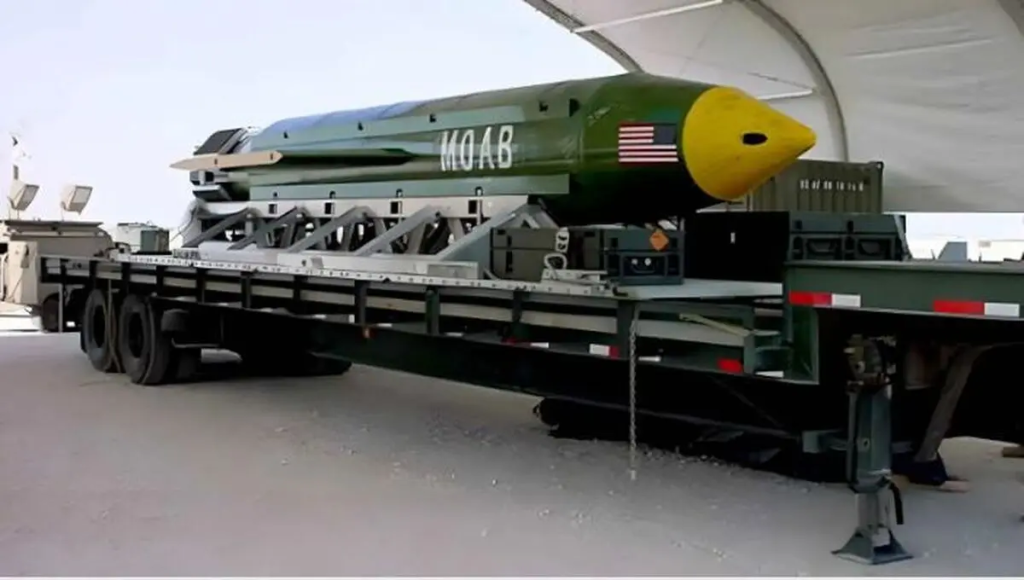
The phrase “America’s Mother of All Bombs versus Iran’s Father of Missiles” symbolizes this confrontation: a clash between massive destructive power and a strategy aimed at increasing the costs of war for the aggressor. But the fundamental question remains: Can military superiority translate into political victory?
United States: Destructive Power and Strategic Limitations
The United States possesses some of the world’s most advanced weapons, extensive airpower, and considerable intelligence capabilities. However, the experience of past wars has shown that destroying military targets does not necessarily lead to the achievement of all political objectives.
In 2017, the United States used the massive non-nuclear GBU-43/B bomb, commonly known as the “Mother of All Bombs,” against ISIS positions in Afghanistan. Despite its destructive power, the use of this weapon alone cannot serve as a measure of the success or failure of a military strategy. The bomb also differs from specialized weapons designed to penetrate deeply buried underground facilities.
In Iran’s case, facilities located in mountainous areas and underground, combined with the country’s complex geography, could make military objectives more difficult to achieve, although the vulnerability of these facilities depends on technical conditions and the type of attack.
Iran: Missiles and the Logic of Deterrence
Over the past several decades, Iran has invested in developing missiles and drones to increase the cost of any potential attack. These capabilities could complicate the military calculations of the United States and its regional allies.
However, missile deterrence does not mean complete immunity from attack. A large-scale war could inflict severe damage on economic infrastructure, critical facilities, and civilian life.
Nevertheless, one lesson that can be drawn from military confrontations involving Iran and the United States, as well as Iran and Israel, is that achieving strategic objectives through military strikes is extremely difficult, particularly against a country with Iran’s geographical characteristics. Its vast territory, rugged terrain, mountainous regions, and the geographical dispersion of strategic facilities could make the planning and execution of military operations more complicated.
From this perspective, even superior weaponry and the use of the most destructive weapons do not necessarily guarantee the achievement of strategic objectives. Military destruction is not the same as political victory, and imposing political will on a country as large and geographically complex as Iran would face significant obstacles.
Will the Next War Bring an End to US Hegemony?
If the United States fails to achieve its declared objectives through military pressure, its deterrence credibility could suffer, potentially altering the global balance of power.
Iran, meanwhile, could incur enormous economic and human costs despite retaining its ability to respond. Nevertheless, Iran’s resistance to military pressure from one of the world’s greatest military powers has highlighted its strategic position in regional and international calculations.
Furthermore, extensive attacks on Iran’s nuclear facilities could heighten concerns that Tehran might place greater emphasis on nuclear deterrence in its security calculations. Such a development would intensify the risk of an arms race and regional instability.
Regional Consequences and the Risk of an Expanding War
If the conflict escalates, the Gulf states, energy transit routes, regional trade, and neighboring countries, including Afghanistan, could face economic and security consequences.
Rising energy prices, disruptions to trade, migration pressures, and border insecurity are among the potential risks of such a scenario. Preventing the expansion of the war is therefore not only the responsibility of the principal parties but also a necessity for all countries in the region.
Final Word: Destructive Power Is Not the Same as Political Victory
The confrontation between Iran and the United States is a test of military technology, political will, and crisis management. The United States may possess air superiority and advanced weapons, while Iran can use its missile capabilities and geographical depth to increase the costs of war. Yet none of these factors alone can guarantee the final outcome.
The Mother of All Bombs may symbolize destructive power, while the Father of Missiles may symbolize deterrence. But bombs and missiles alone do not determine the fate of a war. A lasting victory has meaning only when national security is preserved, people are protected from widespread harm, and the crisis leads to a sustainable political agreement.
The greatest danger is that both sides may confuse their ability to inflict damage on each other with their ability to impose their political will. Starting a war may be easier than containing its consequences.
In the author’s view, developments in this confrontation so far indicate that Iran has held the upper hand, contrary to the assessments of many strategists, while the United States has encountered a strategic deadlock.
However, if the United States fails to achieve its predetermined objectives in this round of the war—as the author predicts—the consequences could extend far beyond a limited military defeat. According to some perspectives and analyses of the future of the global order, such an outcome could weaken US hegemony and lead to the emergence of new powers. In this evolving landscape, Iran could also become a more prominent actor in the international system.
By Dr. Abdul Rauf Tawan | DID News Agency