DID Press: Maulana Fazlur Rehman, leader of Pakistan’s Jamiat Ulema-e-Islam (F), has challenged Field Marshal Asim Munir to resign from the military and contest elections if he intends to play a political role, in one of the strongest public criticisms of Pakistan’s military leadership in recent years.
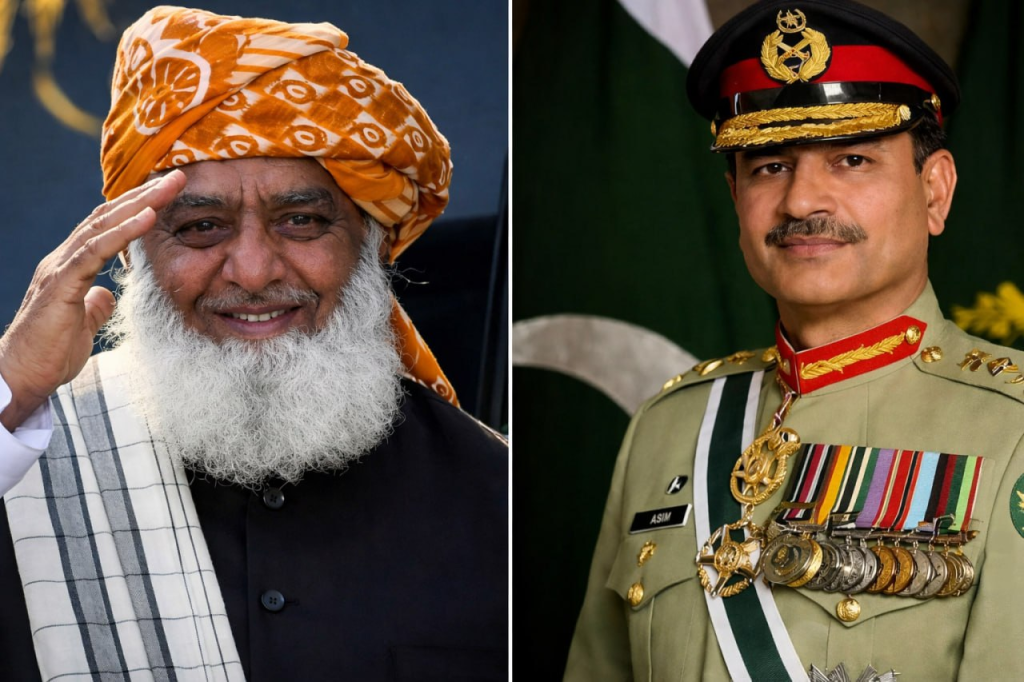
Maulana Fazlur Rehman, son of Mufti Mahmood, has led Jamiat Ulema-e-Islam (F) since the party split in the 1980s and has remained a prominent figure in Pakistan’s religious and parliamentary politics. His party enjoys significant support in Khyber Pakhtunkhwa and Balochistan, and he has served multiple terms in the National Assembly since 1988.
Widely regarded as a long-time supporter of the Afghan Taliban, Fazlur Rehman has consistently advocated closer ties between Islamabad and Kabul. Following the Taliban’s return to power in 2021, he called on Pakistan to recognize the Taliban-led government while maintaining that armed struggle is not a legitimate means of implementing Islamic law.
He also played a central role in the Pakistan Democratic Movement (PDM), the opposition alliance that ousted former Prime Minister Imran Khan through a no-confidence vote in 2022. Following Khan’s removal, the coalition government led by Shehbaz Sharif appointed Asim Munir as Chief of Army Staff after Khan had previously removed him as head of Pakistan’s Inter-Services Intelligence (ISI).
In recent months, Fazlur Rehman has increasingly distanced himself from the ruling coalition, criticizing its domestic policies, governance, and power-sharing arrangements. He has also questioned the military’s approach toward Afghanistan, criticized Pakistan’s cross-border strikes, and challenged the army’s handling of tensions with India.
Speaking on 12 July, he further claimed that the Pakistani government had lost effective control over large parts of Balochistan, describing the province’s security situation as evidence of weakening state authority.
His sharpest criticism came when he directly addressed Field Marshal Asim Munir, saying: “If you want to do politics, take off your uniform and contest elections. Then we will see how many votes the military receives.” The remarks are widely viewed as one of the most direct public challenges to the military’s political influence in Pakistan.